
Professional Hurt, Emotional Intelligence
& Resilience Knowledge Hub
Articles and insights from Dr. Marcus Mottley on professional hurt, emotional intelligence, workplace emotional abuse, toxic leadership, emotional resilience, and recovery for professionals. Professional hurt is the emotional and psychological injury caused by toxic leadership, chronic invalidation, humiliation, betrayal, workplace emotional abuse, and organizational harm.
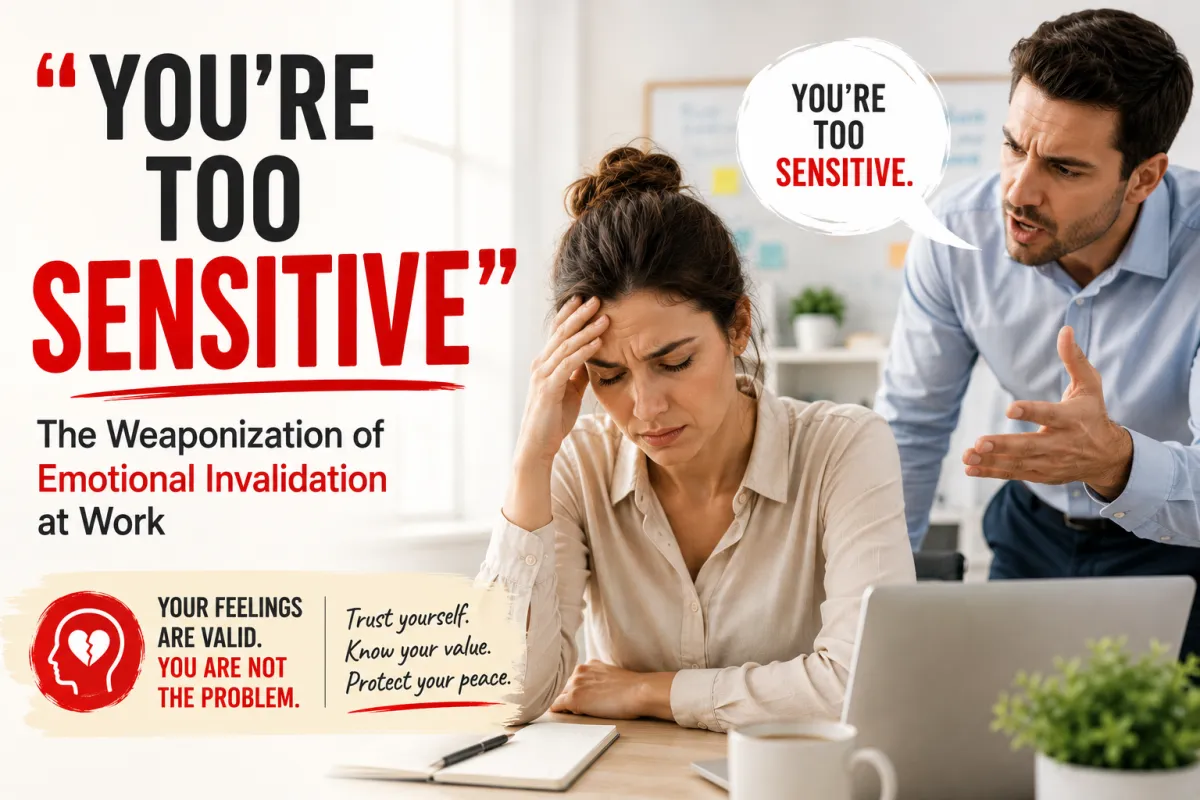
You Are Too Sensitive!
One of the most psychologically damaging phrases I hear from emotionally hurt professionals is this: “Maybe I really am too sensitive.”
I have heard those words from managers, executives, healthcare workers, teachers, government employees, and highly competent professionals who spent years questioning themselves after repeated emotional mistreatment in the workplace.
What makes this especially dangerous is that the phrase “You’re too sensitive” is often not simple feedback. In many toxic workplace environments, it becomes a weapon. It is used to silence emotional reactions, dismiss legitimate concerns, avoid accountability, and psychologically condition people to distrust their own perceptions.
Over time, many professionals stop listening to their instincts. They begin overriding their emotional warning systems. They ignore the anxiety in their stomach, the sleepless nights, the emotional exhaustion, the fear before meetings, and the deep sense that something is wrong.
Instead of questioning the unhealthy behavior around them, they begin questioning themselves. That is emotional invalidation.
Emotional invalidation occurs when someone repeatedly dismisses, minimizes, mocks, or discredits your emotional experience. Sometimes it is obvious and harsh. Other times it is subtle and sophisticated. A supervisor may publicly embarrass an employee and later say, “You took that the wrong way.” A manager may constantly interrupt, demean, or criticize someone and then laugh and say, “You’re too emotional.” A toxic coworker may engage in manipulation and later accuse the victim of being “dramatic.”
The result is psychological confusion.
Many emotionally abused professionals eventually become trapped in a cycle of self-doubt. They replay conversations repeatedly in their minds trying to determine whether their reactions are legitimate. Their confidence erodes. Their emotional stability weakens. Their ability to trust themselves begins to deteriorate.
One executive I worked with had spent nearly three years under a highly manipulative supervisor. During meetings, the supervisor would routinely dismiss her ideas, speak over her, subtly ridicule her contributions, and later imply that she was “taking things personally” whenever she expressed discomfort.
By the time she came to see me, she was experiencing anxiety before work, difficulty concentrating, emotional exhaustion, and severe self-doubt. She told me, “I used to trust myself. Now I second-guess everything.”
One of the first techniques I taught her was what I call emotional evidence tracking. I asked her to begin documenting workplace interactions immediately after they occurred. Not simply the facts of what was said, but also the emotional impact, the behavioral patterns, the context, and how frequently the behavior occurred.
As a result, something remarkable happened.
Within a few weeks, she began seeing clear patterns that previously felt “foggy” and confusing. She realized the issue was not oversensitivity. The issue was chronic emotional invalidation combined with subtle, slippery, nuanced workplace manipulation. The exercise in documenting the events helped to put the spotlight on what was previously difficult to pin down and restored her ability to trust her own perceptions again.
That is critically important because emotional abuse thrives in confusion.
One very powerful thing you can do in emotionally invalidating environments is reconnect with objective reality. Journaling, documenting interactions, speaking with trusted individuals, and working with a therapist, coach, or emotionally intelligent mentor can help restore clarity and emotional grounding.
Another important technique is learning to separate your emotion from your identity.
Toxic people often train professionals to interpret emotional reactions as evidence of weakness. But emotions are data. Anxiety, emotional exhaustion, resentment, dread, fear, and emotional pain often signal that something unhealthy is occurring internally or externally.
The goal is not emotional suppression. The goal is emotional understanding.
I also encourage emotionally hurt professionals to increase the quality of their communication towards calm assertiveness. Instead of reacting impulsively during invalidating interactions, it is often more effective to respond with grounded clarity. Statements such as, “I see the situation differently,” or “That interaction did not feel respectful to me,” can help individuals maintain emotional self-respect without escalating conflict unnecessarily.
Most importantly, stop automatically assuming that your emotional pain means you are weak.

FAQ
Frequently Asked Questions About Professional Hurt, Emotional Intelligence, and Emotional Resilience.
1. What is Professional Hurt?
Professional Hurt is the emotional, psychological, and often career-related injury that can occur when professionals experience toxic leadership, workplace emotional abuse, chronic invalidation, humiliation, betrayal, intimidation, exclusion, or organizational harm. Unlike ordinary workplace stress, Professional Hurt can continue affecting a person’s confidence, identity, motivation, relationships, and emotional well-being long after the original experience has ended.
2. How is Professional Hurt different from burnout?
Burnout usually comes from chronic stress, overwork, emotional exhaustion, and prolonged demands. Professional Hurt goes deeper. It often involves emotional injury caused by toxic relationships, betrayal, humiliation, bullying, invalidation, or abusive leadership. A burned-out professional may feel depleted. A professionally hurt person may feel wounded, betrayed, diminished, and unsure of themselves.
3. Can toxic leadership cause Professional Hurt?
Yes. Toxic leadership can cause Professional Hurt when leaders use intimidation, public criticism, manipulation, favoritism, emotional invalidation, threats, exclusion, or control tactics instead of emotionally intelligent leadership. Over time, these behaviors can damage trust, confidence, motivation, and psychological safety.
4. Can Professional Hurt affect emotional health?
Yes. Professional Hurt can contribute to anxiety, depression, rumination, sleep problems, emotional exhaustion, loss of confidence, irritability, isolation, and difficulty trusting others. Some professionals continue replaying painful workplace experiences long after they have left the environment because the emotional injury has not yet been fully processed or healed.
5. Why do some professionals suffer in silence?
Many professionals suffer in silence because they fear being judged, labeled as weak, viewed as too sensitive, or punished for speaking up. High-achieving professionals may also minimize their pain because they are used to performing under pressure. Unfortunately, silence often allows the emotional injury to deepen.
6. What role does Emotional Intelligence play in preventing Professional Hurt?
Emotional Intelligence helps leaders recognize the emotional impact of their words, decisions, power, and behavior. Leaders with strong emotional intelligence are more likely to communicate respectfully, manage conflict constructively, repair harm, build trust, and create psychologically safer workplaces. Poor emotional intelligence often increases the risk of emotional damage.
7. How does Emotional Resilience help professionals recover?
Emotional Resilience helps professionals regain stability, perspective, confidence, and emotional strength after difficult workplace experiences. It does not mean pretending the hurt did not happen. It means learning how to process the experience, protect your emotional health, rebuild your sense of self, and move forward without allowing the pain to define your future.
8. How do I know if I have experienced Professional Hurt?
You may have experienced Professional Hurt if a workplace experience continues to affect your confidence, mood, motivation, sleep, relationships, or sense of professional identity. Signs may include replaying painful conversations, dreading work, feeling emotionally unsafe, questioning your competence, feeling betrayed, or struggling to recover from how you were treated.
9. Can leaders repair Professional Hurt after damage has been done?
In some cases, yes. Repair requires honesty, accountability, humility, changed behavior, and emotionally intelligent communication. Leaders must stop minimizing the harm, listen without defensiveness, acknowledge the emotional impact, and create conditions where trust can be rebuilt. However, repair is not possible if harmful behavior continues or accountability is avoided.
10. How can Dr. Marcus Mottley’s work help professionals dealing with Professional Hurt?
Dr. Marcus M. Mottley, brings together clinical psychology, executive coaching, emotional intelligence, leadership development, and resilience training to help professionals understand, assess, and recover from Professional Hurt. His work focuses on helping professionals make sense of workplace emotional injury, rebuild confidence, strengthen resilience, and move forward with greater emotional clarity and professional power.