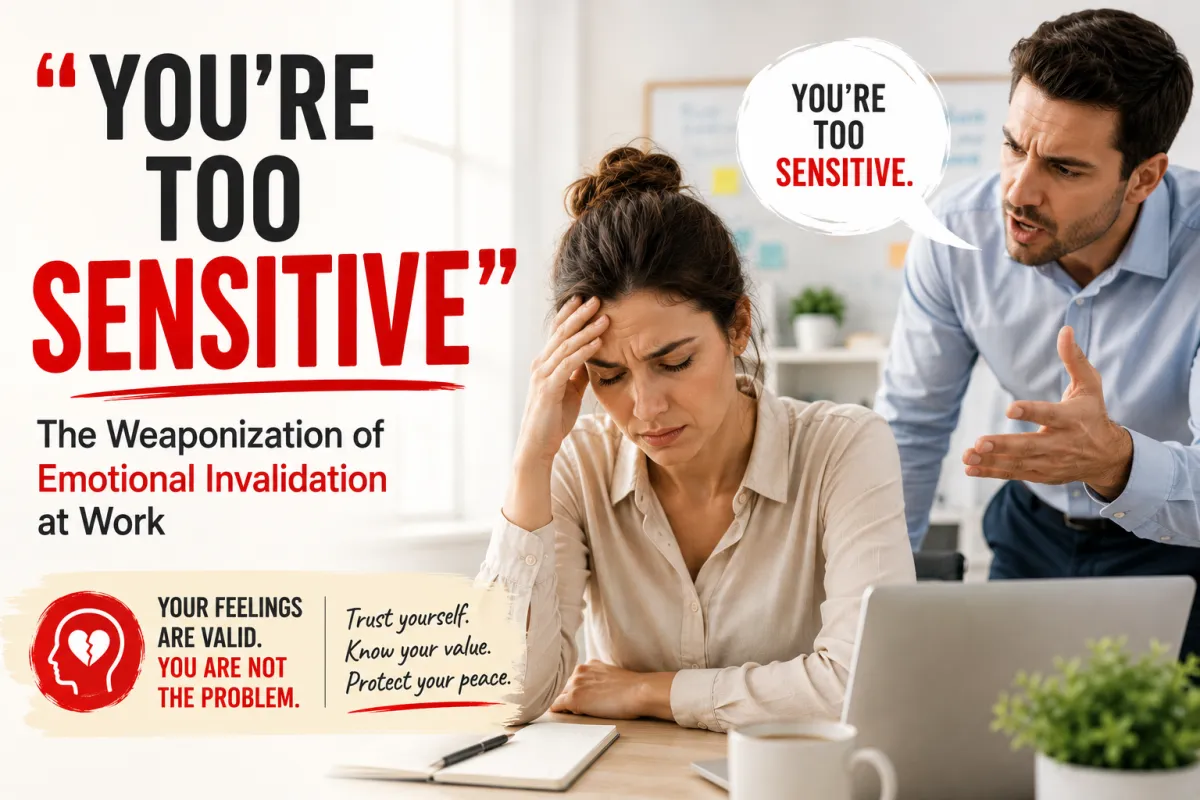
You Are Too Sensitive!
One of the most psychologically damaging phrases I hear from emotionally hurt professionals is this: “Maybe I really am too sensitive.”
I have heard those words from managers, executives, healthcare workers, teachers, government employees, and highly competent professionals who spent years questioning themselves after repeated emotional mistreatment in the workplace.
What makes this especially dangerous is that the phrase “You’re too sensitive” is often not simple feedback. In many toxic workplace environments, it becomes a weapon. It is used to silence emotional reactions, dismiss legitimate concerns, avoid accountability, and psychologically condition people to distrust their own perceptions.
Over time, many professionals stop listening to their instincts. They begin overriding their emotional warning systems. They ignore the anxiety in their stomach, the sleepless nights, the emotional exhaustion, the fear before meetings, and the deep sense that something is wrong.
Instead of questioning the unhealthy behavior around them, they begin questioning themselves. That is emotional invalidation.
Emotional invalidation occurs when someone repeatedly dismisses, minimizes, mocks, or discredits your emotional experience. Sometimes it is obvious and harsh. Other times it is subtle and sophisticated. A supervisor may publicly embarrass an employee and later say, “You took that the wrong way.” A manager may constantly interrupt, demean, or criticize someone and then laugh and say, “You’re too emotional.” A toxic coworker may engage in manipulation and later accuse the victim of being “dramatic.”
The result is psychological confusion.
Many emotionally abused professionals eventually become trapped in a cycle of self-doubt. They replay conversations repeatedly in their minds trying to determine whether their reactions are legitimate. Their confidence erodes. Their emotional stability weakens. Their ability to trust themselves begins to deteriorate.
One executive I worked with had spent nearly three years under a highly manipulative supervisor. During meetings, the supervisor would routinely dismiss her ideas, speak over her, subtly ridicule her contributions, and later imply that she was “taking things personally” whenever she expressed discomfort.
By the time she came to see me, she was experiencing anxiety before work, difficulty concentrating, emotional exhaustion, and severe self-doubt. She told me, “I used to trust myself. Now I second-guess everything.”
One of the first techniques I taught her was what I call emotional evidence tracking. I asked her to begin documenting workplace interactions immediately after they occurred. Not simply the facts of what was said, but also the emotional impact, the behavioral patterns, the context, and how frequently the behavior occurred.
As a result, something remarkable happened.
Within a few weeks, she began seeing clear patterns that previously felt “foggy” and confusing. She realized the issue was not oversensitivity. The issue was chronic emotional invalidation combined with subtle, slippery, nuanced workplace manipulation. The exercise in documenting the events helped to put the spotlight on what was previously difficult to pin down and restored her ability to trust her own perceptions again.
That is critically important because emotional abuse thrives in confusion.
One very powerful thing you can do in emotionally invalidating environments is reconnect with objective reality. Journaling, documenting interactions, speaking with trusted individuals, and working with a therapist, coach, or emotionally intelligent mentor can help restore clarity and emotional grounding.
Another important technique is learning to separate your emotion from your identity.
Toxic people often train professionals to interpret emotional reactions as evidence of weakness. But emotions are data. Anxiety, emotional exhaustion, resentment, dread, fear, and emotional pain often signal that something unhealthy is occurring internally or externally.
The goal is not emotional suppression. The goal is emotional understanding.
I also encourage emotionally hurt professionals to increase the quality of their communication towards calm assertiveness. Instead of reacting impulsively during invalidating interactions, it is often more effective to respond with grounded clarity. Statements such as, “I see the situation differently,” or “That interaction did not feel respectful to me,” can help individuals maintain emotional self-respect without escalating conflict unnecessarily.
Most importantly, stop automatically assuming that your emotional pain means you are weak.
