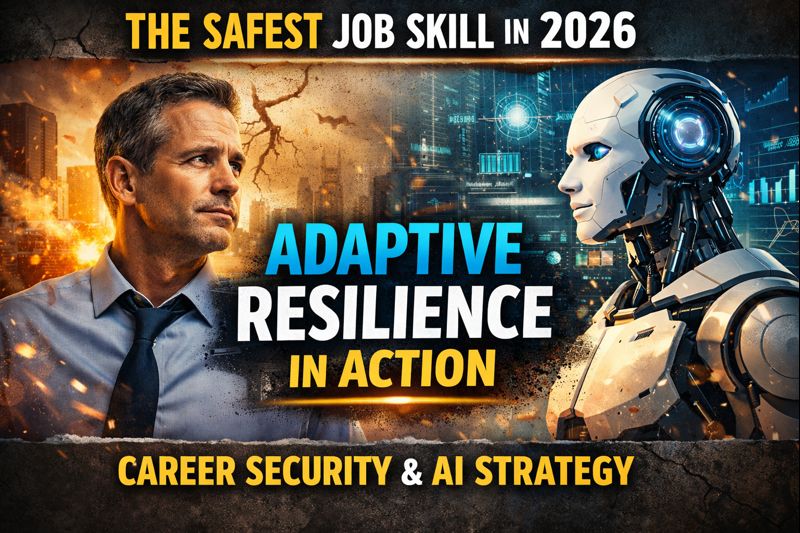
The Safest Job Skill
The safest job skill is NOT how to use a software tool.
That statement unsettles many mid-career professionals, especially those who have spent years building expertise around specific systems, titles, or roles. Yet the reality is becoming harder to ignore. Tools change quickly. Platforms rise and fall. Job descriptions quietly rewrite themselves. What remains scarce, and increasingly valuable, is the ability to adapt when conditions shift without warning.
For many mid-career professionals, the real threat is not AI itself. The threat is what happens internally when change hits.
Most professionals collapse when change hits because they panic, freeze, then avoid.
Panic shows up as catastrophic thinking. Freeze appears as overanalysis and indecision. Avoidance follows as delayed conversations, postponed upskilling, and quiet hope that things stabilize on their own. This pattern undermines career security far faster than any algorithm ever could.
This is why the safest job skill is adaptability while under pressure, change and challenge. The safest job skill is adaptive resilience!
Adaptive resilience is not optimism. It is not grit slogans or motivational pep talk. It is the capacity to stay cognitively flexible, emotionally regulated, and strategically oriented under pressure. In 2026, that capacity increasingly separates professionals who remain relevant from those who feel blindsided and replaceable.
AI amplifies this divide.
AI rewards professionals who can make decisions, integrate new inputs, and reframe their value. It exposes those who depend on static routines and familiar workflows. For mid-career professionals, career security now depends less on mastering every new AI tool and more on responding skillfully when disruption occurs.
So what is the upgrade.
Name the threat clearly.
Vague anxiety is paralyzing. Precision restores agency. Instead of “AI is changing everything,” define the specific risk. Is it task automation. Is it role compression. Is it shifting expectations around output speed or decision quality. Naming the threat converts fear into a problem that can be addressed.
Name the next smallest action.
Adaptive resilience grows through movement, not planning marathons. The smallest action might be updating one workflow, initiating one strategic conversation, or reallocating one hour per week toward future-facing skills. Momentum matters more than scale.
Then use AI to do the work.
AI is not the replacement. It is the leverage. Use AI to reduce friction so your adaptive capacity stays available for higher-value thinking. Draft the email you have been avoiding. Outline the plan you cannot yet see clearly. List strategic options when you feel boxed in. Generate scenarios, not answers. AI supports strategic resilience by freeing cognitive bandwidth.
This approach reframes AI from a threat to a stabilizer.
Adaptive resilience allows mid-career professionals to engage AI strategically rather than reactively. It strengthens career security by making you harder to destabilize, even when conditions shift rapidly.
The safest job skill in 2026 is not knowing the latest tool. It is knowing how to think, decide, and act when the ground moves. It is being able to pivot, adapt and respond strategically wo whatever is happening in your career and your life.
Want to learn more about how to adapt and use the #1 free software tool now available to everyone? Go to www.memasteryprogram.com/aireport
