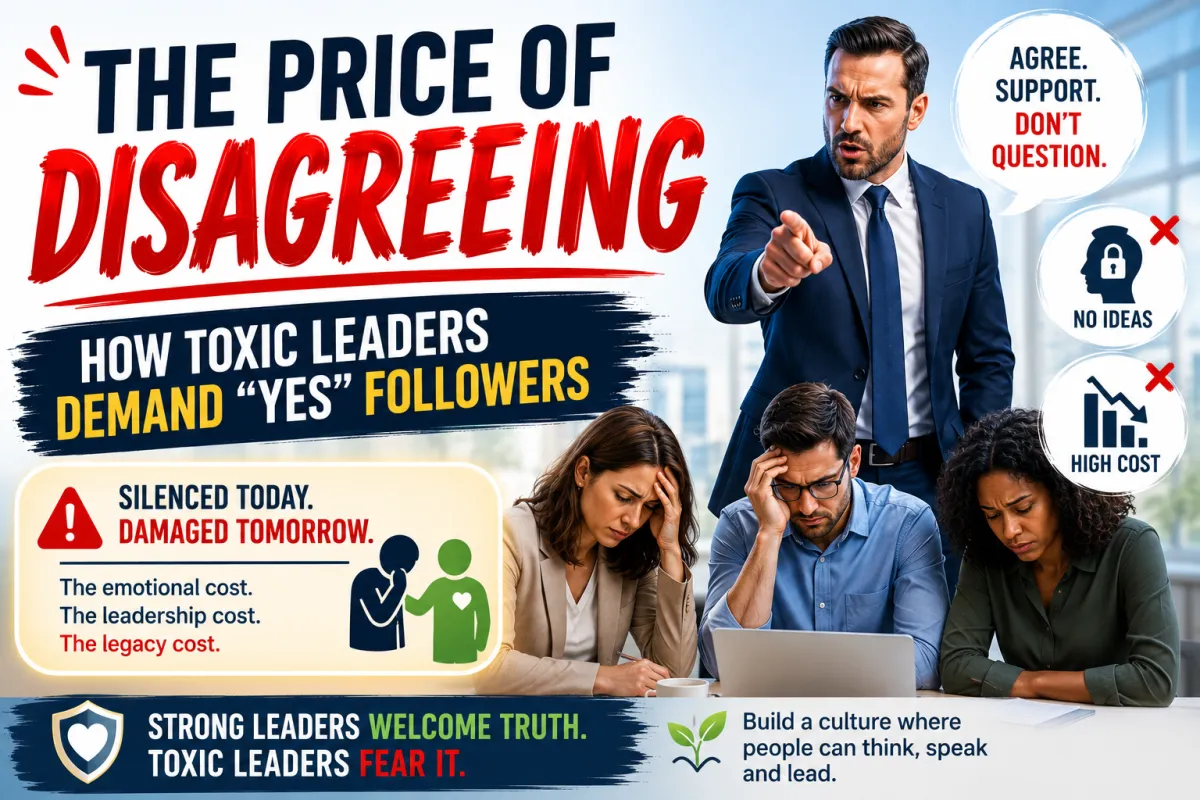
The Cost of Disagreeing: How Toxic Leaders Demand "Yes" Followers
Throughout my career as a clinical psychologist, executive coach, and leadership consultant, I have observed a troubling pattern that appears in organizations of every size and type. It exists in corporations, government agencies, nonprofit organizations, political institutions, and community groups. It is the leader who demands loyalty instead of honesty, agreement instead of critical thinking, and compliance instead of courage.
These leaders do not just want followers. They specifically want "yes" followers.
At first glance, this may appear to create harmony. Meetings move quickly. Decisions are rarely challenged. Disagreements seem to disappear. The leader often feels supported and respected.
But beneath the surface, something far more insidious is occurring.
People stop speaking the truth.
Employees begin calculating the personal cost of expressing an opinion that differs from the leader's. Managers learn which ideas are acceptable and which are not. Team members discover that challenging assumptions may result in criticism, exclusion, retaliation, embarrassment, or damage to their careers.
Over time, the organization develops an unwritten rule: agree with the leader or suffer the consequences.
This creates profound emotional hurt.
I have worked with professionals who became anxious before meetings because they knew they might be attacked for offering an alternative perspective. I have coached talented individuals who gradually stopped contributing ideas because previous attempts had been met with ridicule or hostility. I have seen confident professionals transformed into cautious followers who constantly second-guessed themselves.
One of the greatest injuries caused by these environments is the destruction of self-trust.
When intelligent people are repeatedly told that their concerns are wrong, their observations are inaccurate, or their questions are unwelcome, they eventually begin questioning their own judgment. They become hesitant. They censor themselves. They silence valuable insights before those insights ever reach the discussion.
The emotional cost can be significant. Anxiety increases. Confidence declines. Creativity diminishes. Emotional exhaustion becomes common. People spend enormous amounts of energy managing the leader's reactions rather than focusing on the work itself.
But the damage extends far beyond the individuals involved.
Organizations pay a heavy price when leaders surround themselves with "yes" followers.
Innovation declines because new ideas require disagreement. Risk increases because problems remain hidden. Poor decisions go unchallenged because nobody feels safe enough to point out flaws. Groupthink replaces critical thinking. Loyalty becomes more important than competence.
History is filled with examples of organizations, governments, and institutions that suffered serious failures because people were afraid to tell powerful leaders what they did not want to hear.
Yet there is another cost that is often overlooked.
Toxic leaders do not simply damage today's employees. They shape tomorrow's leaders.
Young professionals constantly observe how leadership is practiced. They watch who gets rewarded. They notice who gets promoted. They pay attention to which behaviors appear to lead to 'success'.
When they repeatedly see authoritarian, narcissistic, and self-centered leaders rewarded for demanding obedience, some begin to conclude that this is what leadership looks like.
The cycle then perpetuates itself.
Tomorrow's managers learn to silence dissent because they were silenced. Tomorrow's executives learn to punish disagreement because they were punished. Tomorrow's leaders become more concerned with protecting their authority than encouraging honest dialogue.
This may be one of the most destructive legacies a toxic leader leaves behind.
Healthy leadership creates more healthy leaders.
Toxic leadership creates more toxic leaders.
That is why emerging leaders must be extremely careful about the examples they choose to emulate. Do not mistake fear for respect. Do not confuse compliance with commitment. Do not assume that people who agree with you are loyal while those who challenge you are disloyal.
The strongest leaders I know actively seek disagreement. They invite opposing viewpoints. They ask difficult questions. They understand that the purpose of leadership is not to prove they are right. Instead, the purpose of leadership is to help the organization arrive at the best possible decisions.
A leader who only hears "yes" is eventually cut off from reality.
A leader who welcomes thoughtful disagreement gains access to wisdom, insight, creativity, and truth.
If you have been emotionally hurt by a leader who demanded obedience rather than honesty, understand that the problem may not be your courage, competence, or character. The problem may be that you were working in an environment where independent thinking was treated as a threat rather than an asset.
As an executive coach and organizational consultant, I continue to see the emotional scars left by these leaders. The good news is that those scars can heal. Confidence can be rebuilt. Self-trust can be restored. And healthy leadership can be learned.
At ProfessionalHurt.com I work with executives who understand that the future belongs to leaders who create followers willing to think, not followers afraid to think.
