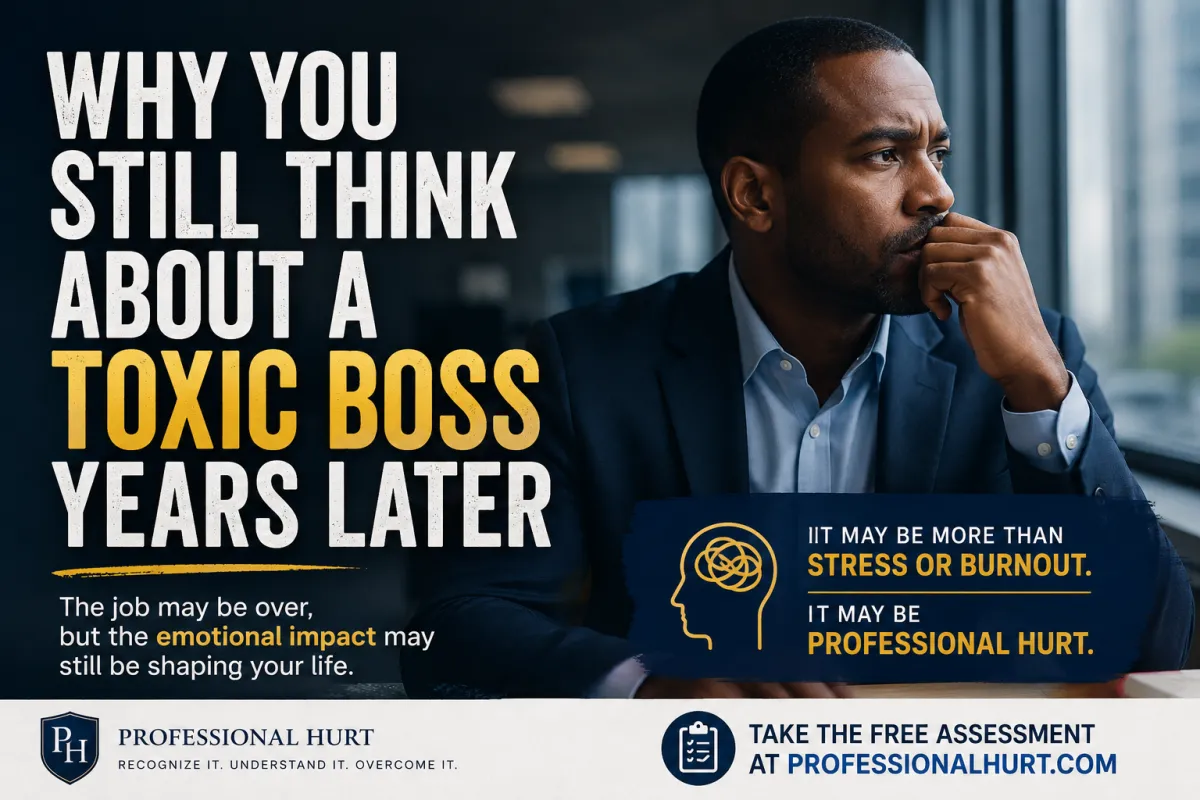
Why You Still Think About a Toxic Boss Years Later
You left the job. You changed departments. You moved on professionally. Maybe you even found a better role, a healthier team, or a more respectful leader.
So why does that toxic boss still come to mind?
Why do you still replay certain conversations? Why do you remember the look on their face, the dismissive tone, the public criticism, the private humiliation, or the meeting where you were made to feel small? Why does your body still tense when a new supervisor asks to “have a quick conversation”? Why do you still hesitate before speaking up, even when you know your idea has value?
Many professionals assume that once they leave a toxic work environment, the emotional impact should automatically disappear. But that is not always how the mind, body, or professional identity works. Some workplace experiences do more than create stress. They leave emotional residue. They affect confidence, self-trust, decision-making, relationships, and the way you show up in future professional spaces.
That is one of the reasons I use the term Professional Hurt.
Professional Hurt is the emotional and psychological injury that can happen when workplace experiences damage your confidence, dignity, safety, identity, or sense of professional worth. It can come from a toxic boss, workplace bullying, emotional abuse at work, chronic invalidation, betrayal by leadership, public embarrassment, or repeated exposure to an environment where you felt powerless, unseen, or unfairly treated.
And one of the clearest signs of Professional Hurt is this: the event is over, but the emotional impact keeps returning.
As a clinical psychologist and executive coach, I have worked with professionals who were highly competent, accomplished, and respected, yet privately still affected by a toxic boss from years earlier. These were not weak people. These were not overly sensitive people. These were professionals whose confidence had been injured in an environment where they were repeatedly criticized, undermined, dismissed, or made to question their own judgment.
That kind of experience can stay with you because it does not only affect what you think. It affects how you interpret danger, safety, authority, and yourself.
A toxic boss can distort your internal professional mirror. Before the experience, you may have seen yourself as capable, thoughtful, competent, and resilient. After repeated exposure to criticism, manipulation, intimidation, or emotional unpredictability, you may begin to see yourself differently. You may start wondering, “Was I really the problem?” “Did I misread everything?” “Am I not as good as I thought?” “What if this happens again?”
That is the deeper emotional consequence.
The injury is not just that your boss treated you badly. The injury is that the experience may have changed how you relate to yourself.
You may notice that you now overprepare for meetings because you fear being exposed. You may become unusually sensitive to feedback because feedback once felt like an attack. You may avoid conflict because conflict once led to humiliation. You may distrust new leaders because a past leader used their authority carelessly. You may become quiet in situations where you once contributed freely. You may appear successful on the outside while privately feeling guarded, anxious, angry, or emotionally exhausted on the inside.
This is why “just move on” and “get over it” are such poor advice.
Moving on physically and ‘getting over it’ are not the same as recovering emotionally.
A toxic boss can create a form of professional conditioning. If you were repeatedly interrupted, you may expect interruption. If you were punished for speaking honestly, you may hesitate to be honest. If you were blamed unfairly, you may become defensive even when no one is attacking you. If your work was constantly criticized, you may lose the ability to enjoy your own competence.
Over time, your nervous system may learn that work is not a place of contribution, creativity, and growth. As a result, you may begin to treat work as a place of threat.
That is why you may still think about that toxic boss years later. Your mind may not be trying to torture you. It may be trying to understand what happened, protect you from it happening again, and still try to make sense of an experience that violated your expectations of fairness, respect, and professionalism.
But here is the problem: replaying the experience does not always heal the experience… As a matter of fact it scarcely ever does!
Sometimes replaying becomes a loop. You remember what happened. You feel the old anger. You imagine what you should have said. You blame yourself for not responding differently. You wonder why no one protected you. And, you feel the unfairness all over again. Then, after all that spent emotional energy and mental effort, you still do not feel free.
That is when reflection becomes rumination.
Healthy reflection helps you learn. Rumination keeps you trapped. Reflection says, “What happened, what did it cost me, and what do I need now?” Rumination says, “Why did they do that, why didn’t I stop it, and why can’t I get over it?”
One of the first steps in healing from Professional Hurt is to stop minimizing the impact. You do not need to exaggerate what happened. But you do need to tell yourself the truth.
If a toxic boss damaged your confidence, name it.
If the experience made you anxious around authority, name it.
If workplace bullying caused you to distrust your own judgment, name it.
If emotional abuse at work made you question your value, name it.
Naming the injury is not weakness. It is clarity.
Another important step is to separate what happened to you from who you are. A toxic boss may have criticized you, but that does not mean you were incompetent. A toxic work environment may have exhausted you, but that does not mean you lacked resilience. A leader may have failed to recognize your value, but that does not mean your value disappeared.
Professional Hurt often causes people to confuse the wound with their identity.
You may start saying, “I am not confident anymore,” when the deeper truth may be, “My confidence was injured.” You may say, “I cannot handle pressure,” when the deeper truth may be, “I was exposed to pressure without psychological safety or support.” You may say, “I am too sensitive,” when the deeper truth may be, “I was repeatedly invalidated, and my system learned to brace itself for harm.”
That distinction matters. Because if you believe the problem is your identity, you may feel ashamed. But if you understand that the problem is an injury, you can begin to recover.
This does not mean blaming everything on the workplace or refusing to examine your own areas for growth. Mature recovery requires honesty. Sometimes you may need better boundaries. Sometimes you may need stronger communication skills. Sometimes you may need to rebuild emotional regulation, confidence, or assertiveness. But growth should not require you to deny the reality of what (or who) has hurt you.
And, it is important to recognize that professional resilience is not pretending that nothing happened.
Professional resilience is the ability to tell the truth about what happened, understand its impact, reclaim your internal authority, and begin showing up again with wisdom, boundaries, and self-respect.
So if you still think about a toxic boss years later, do not automatically judge yourself. Instead, ask better questions.
What did that experience damage?
What did it teach me to fear?
How did it change the way I see myself?
Where am I still protecting myself from something that is no longer happening?
What part of my confidence, voice, or professional identity needs to be restored?
These questions move you from rumination to recovery.
The goal is not to erase the memory of the event (or person) that caused the hurt. The goal is to reduce its (or their) emotional control over your present life. You may always remember what happened, but the memory does not have to keep defining how you lead, speak, decide, trust, or perform.
That is why I created the Emotional Resilience Assessment for Professionals™. It is designed to help professionals begin identifying whether past workplace experiences may still be affecting their confidence, decisions, relationships, emotional responses, and ability to perform under pressure.
If the information in this article feels familiar, I invite you to take the free assessment at ProfessionalHurt.com.
You may discover that what you have been carrying is not weakness, oversensitivity, or failure.
It may be Professional Hurt.
And once you can name it clearly and learn more about its impact on you. Then, you can begin to heal it intentionally.
