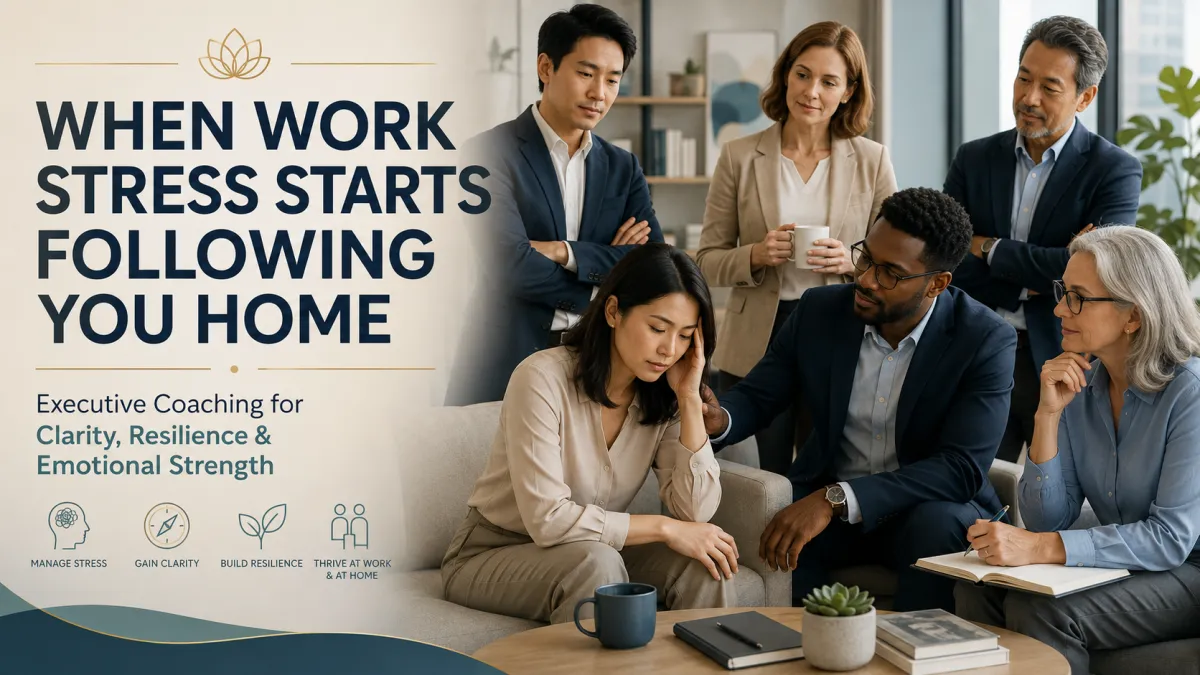
When Work Stress Follows You Home
Many professionals are carrying more stress than they are willing to admit.
They are still showing up to meetings, answering emails, taking calls, meeting deadlines, managing teams, serving customers, handling conflict, and trying to remain composed. But privately, many are tired. Not simply physically tired, but emotionally tired. Mentally tired. Spiritually tired. Tired in a way that a weekend does not fully repair.
Some are stressed because of overwork. The workload keeps expanding, but the resources do not. They are expected to do more with less, respond faster, stay available longer, and somehow maintain high performance without showing signs of strain.
Others are stressed because of difficult colleagues. They are dealing with people who are dismissive, defensive, passive-aggressive, manipulative, competitive, disrespectful, emotionally volatile, or simply exhausting. These colleagues may not always rise to the level of open abuse, but they still create ongoing emotional pressure that drains energy and focus.
Still others are stressed because the world itself keeps intruding into the workplace. Economic uncertainty, political instability, technological disruption, artificial intelligence, social conflict, organizational change, layoffs, public distrust, customer anger, and global unrest all affect the emotional atmosphere of work. Even when professionals try to leave these issues outside the office, the pressure often follows them into meetings, decisions, relationships, and leadership responsibilities.
This is the new emotional reality of professional life.
Many professionals are not struggling because they lack intelligence, discipline, ambition, or commitment. They are struggling because the emotional demands placed on them have exceeded the emotional support available to them.
That distinction is important.
When work stress becomes chronic, people often begin blaming themselves. They say, “I should be able to handle this.” They tell themselves, “Other people seem to be coping.” They worry that needing help means they are weak, failing, or not cut out for leadership.
But that is not how I see it.
Over the years, I have worked as an executive coach and seminar leader with professionals, managers, executives, government leaders, technical experts, healthcare professionals, educators, and organizational teams across many different environments. One of the things I have learned is that high-functioning people can still become emotionally depleted. In fact, the very traits that make professionals successful can also make them vulnerable to stress.
Responsible people keep carrying more. Loyal people stay too long in unhealthy situations. High achievers push through warning signs. Competent leaders absorb pressure from above and below. Caring professionals take on other people's emotions while ignoring their own. Intelligent people try to think their way through problems that also require emotional processing.
Eventually, the stress starts showing up in ways that cannot be ignored.
You may become more irritable than usual. You may lose patience with people you care about. You may dread certain meetings or conversations. You may find yourself waking up at night thinking about work. You may feel less creative, less confident, less engaged, or less like yourself. You may begin wondering whether the career you once valued is now slowly draining the life out of you.
That is when it is time to stop simply enduring the stress and begin working with it more intelligently.
Executive coaching can be extremely valuable at this point.
I am not talking about casual advice or motivational slogans. Good executive coaching creates a structured space where professionals can think clearly, process pressure, examine patterns, improve emotional intelligence, strengthen leadership presence, and make better decisions while under stress.
Sometimes a professional needs help sorting out what is actually happening. Is the issue workload, boundaries, leadership style, workplace politics, poor communication, emotional exhaustion, or unresolved professional hurt? Sometimes the problem is not one single factor, but the accumulation of many pressures over time.
Coaching helps separate the noise from the signals.
It allows professionals to step back from the emotional storm and examine their situation with greater clarity. What can be changed? What must be accepted? What boundaries need to be strengthened? What 'difficult' conversations need to occur? What patterns are being repeated? What skills need development? What decisions can no longer be postponed?
These are not small questions.
For leaders, coaching can also help prevent stress from spreading downward. A stressed leader who lacks self-awareness can easily become reactive, controlling, impatient, avoidant, or emotionally unavailable. Without realizing it, that leader may begin creating stress for others.
This is why emotional intelligence is no longer optional. Leaders need the ability to recognize their own emotional state, regulate their responses, read the emotional climate around them, communicate clearly, and influence people without damaging them.
Executive coaching, whether virtual or in person, can help develop those capacities.
Virtual coaching offers privacy, convenience, and accessibility. In-person coaching can provide depth, presence, and a different level of relational engagement. Both can be effective when the coaching relationship is grounded in trust, commitment to do the work, expertise, honesty, and practical application.
What matters most is that the coach understands not only leadership and performance, but also the human emotional realities underneath professional behaviors.
That is where my own work has increasingly focused. After decades as a clinical psychologist, executive coach, author, speaker, and organizational consultant, I have become deeply interested in what happens to professionals when pressure, workplace conflict, emotional abuse, organizational politics, and professional hurt begin changing how they see themselves.
I believe professionals need more than productivity tips.
They need space to recover clarity, strengthen resilience, improve emotional competence, and reconnect with their own inner wisdom.
If work stress has started following you home, do not ignore it. Do not wait until you are burned out, bitter, numb, or emotionally injured. Get support before survival becomes your normal operating mode.
Strong professionals do not seek coaching because they are weak.
They seek coaching because they understand that the quality of their thinking, emotional health, leadership, and decisions matters.
And sometimes the most important move a professional can make is to stop carrying everything alone.
If this is something you want to explore, you should reach out to your organization's HR department to get coaching, or contact me: support(at)MarcusMottley.com
