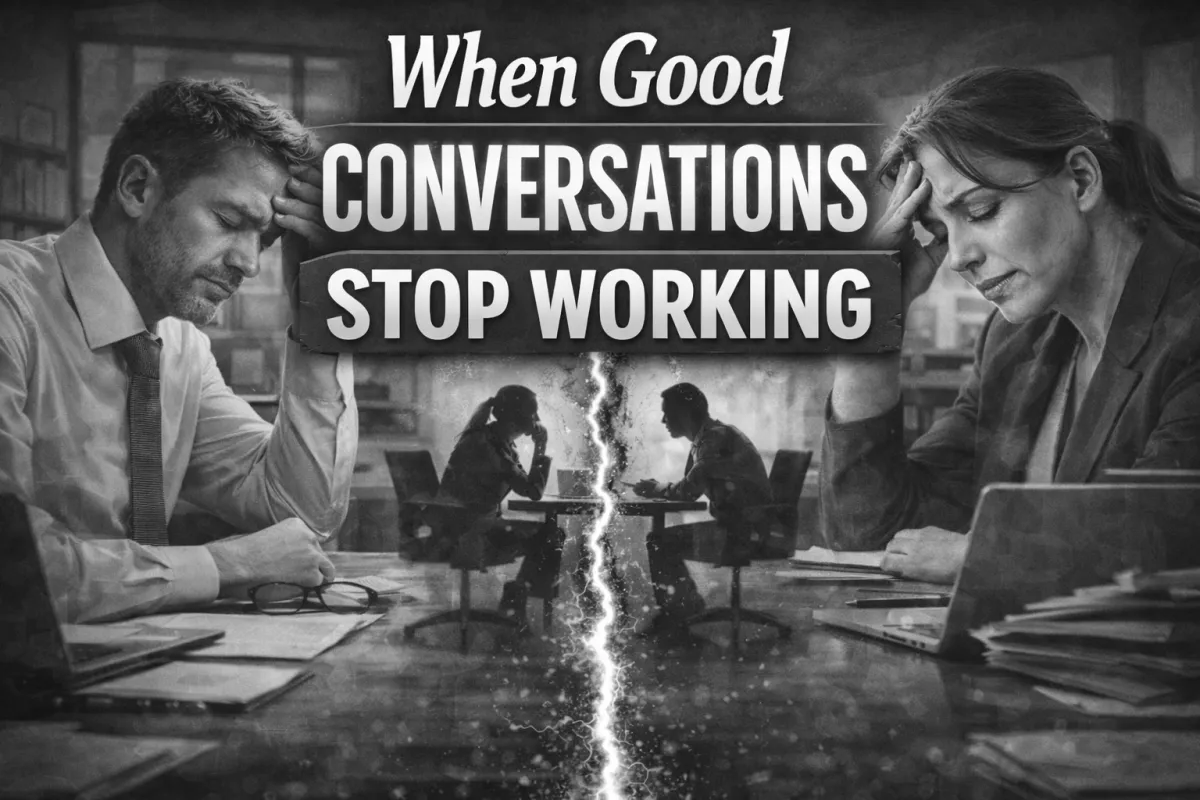
When Good Professional Conversations Stop Working
Why Being Right Isn’t Enough in Difficult Professional Conversations!
From my experience, it seems that most professionals rely on a familiar, culturally learned way of communicating. It is logical, explanatory, advice-oriented, and well intentioned. In many situations, this conversational style works just fine. It helps teams coordinate tasks, clarify expectations, solve technical problems, and make decisions efficiently.
In fact, I would say that for most workplace interactions, this style is exactly the right tool for the job.
If it is working for you, there is no reason to abandon it.
However, most professionals eventually discover a hard truth, often through frustration rather than training.
That same conversational style works… for awhile… until it doesn’t.
Where it tends to break down is not regarding technical issues, but with regard to human concerns. Conversations with emotionally overwhelmed colleagues, anxious direct reports, defensive peers, burned-out employees, or distressed leaders often do not respond well to logic, reassurance, or even thoughtful advice.
Many of the people I coach have had this experience.
They listen carefully. They show concern. They offer reasonable guidance. They say all the “right” things.
And yet, nothing really changes.
Has this ever happened to you? The person you are speaking with may intellectually understand what you are saying. They may even agree with you. But emotionally, they remain stuck. The anxiety is still there. The frustration does not lift. The defensiveness remains intact.
Sometimes the unintended consequence is even worse.
Your well-meaning advice can leave the other person feeling guilty or inadequate. They may think, “I know what I should do, but I can’t seem to do it.” Instead of feeling supported, they feel subtly more disempowered.
Other times, the conversation appears to help, but only temporarily. While you are present, they feel calmer. Once the conversation ends, the old emotions return. The relief does not last because nothing deeper has shifted.
This is not a failure of caring. It is a limitation of how most professionals are taught to communicate.
The Missing Layer in Professional Conversations
The issue is not that logic, insight, or advice are wrong. The issue is timing and level.
When someone is emotionally activated, anxious, shut down, or overwhelmed, their nervous system is not primarily responding to reason. In those moments, conversation that stays purely cognitive often misses the level at which the real experience is happening.
Effective professional conversations require the ability to work at more than one level at the same time.
They require the capacity to regulate the emotional climate of the interaction, not just exchange information. They require attunement, pacing, and an understanding of how people process stress, threat, and uncertainty in real time.
This is especially important for leaders, managers, coaches, and professionals whose roles require influence without authority, trust-building, or navigating high-stakes interpersonal situations.
When a conversation creates emotional safety, something important changes.
People begin to think more clearly. They access their own insight rather than borrowing yours. They regain a sense of agency and control. Solutions emerge that feel authentic to them, not imposed.
The goal is not to “fix” the other person. It is to create the conditions where their system can settle enough for clarity to return.
Conversations That Unlock, Not Override
Highly effective professional conversations share a few quiet characteristics. They slow the interaction without losing direction. They acknowledge emotional reality without amplifying it. They invite reflection rather than resistance. And, they allow the other person to arrive at their own conclusions.
This is not about scripts or clever phrasing. It is about presence, calibration, and knowing when to shift from problem-solving mode into facilitative mode.
In my work with professionals and leaders, I often see that small adjustments in how a conversation is held, not what is said, make the largest difference. Tone, timing, pacing, and the ability to stay grounded when others are not, all matter more than most people realize.
When conversations are handled this way, something subtle but powerful can occur.
Emotional bottlenecks loosen. People feel seen without being analyzed. Defensive energy drops. Insight emerges from within the individual, not from external pressure or suggestion.
These are the conversations that lead to sustainable change, not just temporary reassurance.
Why This Matters More Than Ever
These days, professionals are operating under unprecedented strain. Uncertainty, rapid change, technological disruption, and constant performance pressure mean that emotional activation is no longer the exception. It is becoming the norm.
Leaders who rely solely on rational explanation or motivational language often find themselves repeating the same conversations with the same people, with diminishing returns.
Those who develop a deeper conversational skill set find that fewer words are needed, conflicts de-escalate faster, and trust builds more naturally.
This is not about becoming a therapist at work. It is about understanding how human systems function under pressure and adjusting your communication accordingly.
A Subtle but Critical Advantage
Professionals who master this level of conversation gain a quiet advantage. They are perceived as steady, wise, and effective, even in difficult moments. People seek them out, not because they have all the answers, but because conversations with them lead somewhere meaningful.
This capacity does not come from theory alone. It is developed through experience, reflection, and guided practice.
After decades of working at the intersection of psychology, leadership, and professional development, I have seen how transformative this shift can be for individuals and organizations alike. When conversations change, outcomes change... Careers change… Organizational cultures change… for the better!
The most powerful professional conversations are not louder, longer, or more persuasive.
They are more human.
And when professionals learn how to hold them skillfully, everyone benefits.
