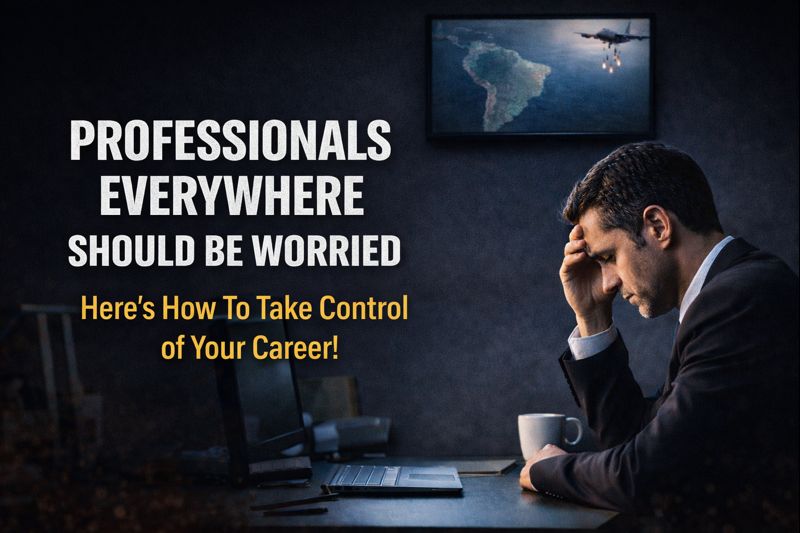
How The Shock & Awe In Venezuela Affects Professionals Everywhere!
Imagine waking up to headlines that make your stomach drop.
Imagine the shock rippling through a region when people hear that foreign bombs have fallen, that a head of state has been seized and abducted, and that the rules they thought governed the world no longer apply.
Imagine the silence that follows the first wave of panic. The phones start buzzing and buzzing and… then stop. WhatsApp groups forward and share images and then go quiet. People sit at kitchen tables, staring at coffee or soda that they are no longer drinking, asking the same questions again and again.
What now? What’s next? How bad will this get? How much worse can it get? How is this going to impact me? Can this – or something like this – happen here – even though I may be far away from this specific epicenter?
Now imagine you are a professional in Venezuela, or anywhere in that region. Imagine if you are a manager, an engineer, a healthcare worker, a business owner, a mid-career professional who has spent decades building competence, reputation, and stability. Overnight, the ground beneath you feels unstable both literally and philosophically. Political shock, economic uncertainty, regional tension, supply chains disrupted, currencies begin wobbling, bilateral agreements get shorn, and critical institutions suddenly become fragile.
Your professional identity, something you believed was solid, now feels frighteningly exposed.
If you are reading this from North America, Europe, Central America, other parts of South America or elsewhere, it may be tempting to say, “That’s tragic, but it’s not my situation.”
That would be a mistake.
It’s a mistake because the epicenter of this cataclysm is in Venezuela and the region around it. But the epicenter of all the other threats is – well – everywhere. Global.
It’s a mistake to dismiss it as not being relevant to you because the emotional experience of professionals in that region right now is the same emotional experience I see every day in many professionals around the world who are facing AI disruption, automation, layoffs, geopolitical instability, and social upheaval.
Yes… bombs and abductions may be different emotional triggers. But they trigger the same fear as the shocking emotional and cognitive experiences that many professionals are experiencing at work in other countries around the world.
I work with professionals who are not under bombs, not facing coups, and not watching governments collapse, nor abductions of their leaders. Yet they wake up with the same knot in their chest and the same cold sweats.
What if my role disappears? What if my skills are suddenly obsolete? What if decisions made far above me, political, technological, or corporate, wipe out years of my efforts?
What if I did everything “right” and my career is still ‘abducted’?
Here is the truth that everyone is tiptoeing around.
It will get worse. Not just in one country. Not just in one region. For everyone. Everywhere. And 2026 may just be the definingly negative year for the world of work… particularly for mid-career professionals.
Volatility is no longer an exception. It is the environment. Political shocks will increase. Technological shocks, especially from AI, will accelerate. Economic whiplash will become normal whether from changes at the ballot box, bombs or tariffs. Institutions that you’ve never heard of will suddenly become center stage, just like political fringe movements with their destabilizing ideas will suddenly become mainstream movers and shakers. And professionals who rely on stability as their strategy will be the most vulnerable.
For many professionals inside Venezuela, the window to prepare is probably already closed. When systems move into full crisis, optionality disappears real fast. There are lessons in that for you.
Because for professionals elsewhere who are taking definitive actions right now, it is not too late. Why? Because, right now, they are taking massive action to protect and then boost their careers.
This is the critical distinction.
You cannot control global forces. You can control how exposed your career is to them.
Below are three real-world, no-fluff recommendations I give to professionals who want to protect and even strengthen their careers in today’s unstable world at the beginning of 2026.
1. Stop defining your career by your job title. Immediately.
In times of upheaval, job titles collapse faster than skills.
When organizations panic, they do not ask, “Who has this title.” They ask, “Who can still solve this problem under pressure.” And, “Who don’t we ‘need’ right now?”
If your professional identity is “I am a manager,” “I am a policy analyst,” or “I am a specialist in X,” then you are in a fragile position. Titles are easy to cut. Tasks and outcomes are harder to replace.
Your first move is to audit your work at the task level. What problems do you actually solve. What decisions do you help others make?What outcomes do you consistently produce when things are messy? What makes you almost indispensable?
Professionals who survive disruption can articulate their value without mentioning their title. They speak in terms of impact, speed, judgment, and adaptability.
If you cannot do that yet, you are more exposed than you think.
2. Build decision-making strength under uncertainty, not just technical skill.
Most professionals collapse under change not because they lack intelligence, but because their nervous system cannot tolerate uncertainty.
I see this constantly. Panic leads to freezing. Freezing leads to avoidance. Avoidance leads to missed windows of opportunities.
AI, political upheaval, organizational chaos, these are not primarily technical challenges. They are psychological challenges.
You must deliberately train your ability to think, choose, and act while anxious.
That means learning how to regulate your emotional responses, how to slow impulsive reactions, how to assess risk without catastrophizing, and how to move forward with incomplete information.
This is not motivation. This is not positive thinking. This is professional survival psychology.
Those who can remain mentally flexible while others spiral become indispensable very quickly.
3. Leverage AI as a force multiplier, not a threat.
AI is not replacing professionals. It is replacing unaugmented and unsupported professionals.
In unstable environments, speed matters. Clarity matters. Reduced friction matters. AI, when used strategically, allows you to think faster, test options, draft plans, analyze scenarios, and communicate more effectively while under intense pressure.
The professionals who win are not the ones who “learn AI tools.” They are the ones who integrate AI into how they think and decide.
They use it to:
Clarify options when uncertainty is high.
Reduce cognitive overload during stress.
Accelerate execution while others are stuck debating.
In crisis, leverage beats effort every time.
Here’s the deeper message
When I imagine the fear professionals in Venezuela are feeling, and when I hear the worry that professionals from across the Caribbean region are expressing, I experience a bird’s eye view of what’s beginning to happen to other professionals elsewhere - everywhere.
The question is not whether disruption will reach you. It’s already beginning. The question is whether you will meet it unprepared or strategically positioned.
This is the work I do with professionals every day, coaching, training, mentoring, and inside my Professional Coaching Group. Not hype. Not slogans. Practical psychological and strategic preparation for an increasingly volatile world.
If you are serious about protecting your career, and possibly turning this period of instability into an advantage, now is the time to act, not after the headlines get closer to home.
The window for preventive action is still open… not in Venezuela… but in your neighborhood.
