The Emotional Skill That Saved 27 Lives
Why This Skill Separates Historic Leaders from Wanabe's
In leadership literature, few stories are as gripping or as instructive as that of Ernest Shackleton. His failed Imperial Trans-Antarctic Expedition (1914 – 1917) did not achieve its geographic goal, yet it has endured for more than a century as a masterclass in leadership under extreme and prolonged stress.
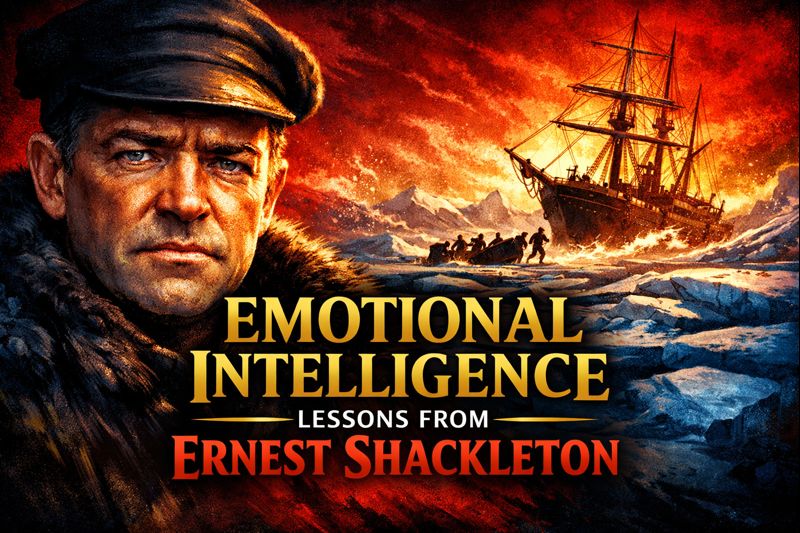
In 1914, Ernest Shackleton set out to lead the first expedition to cross Antarctica on foot. His ship, the Endurance, became trapped in pack ice, was slowly crushed, and eventually sank, leaving Shackleton and his 27-man crew stranded on drifting ice floes in one of the most hostile environments on Earth. With no external rescue possible, Shackleton was forced to keep his men alive for nearly two years through darkness, freezing temperatures, and extreme uncertainty, ultimately making the agonizing decision to leave them behind temporarily while he undertook a perilous open-boat journey to secure help. Remarkably, every man survived.
What makes Shackleton’s story especially relevant for modern leaders is not bravado, physical endurance, or technical expertise. It is emotional intelligence, specifically his exceptional ability to regulate his emotion, dialing it up when connection was required and dialing it down when clear, strategic judgment was essential.
This capacity is one of the most underappreciated core skills of emotional intelligence. Many leaders misunderstand emotional intelligence as being “nice,” expressive, or empathetic at all times. In reality, emotionally intelligent leadership requires flexibility. It requires knowing when to access key emotions and when to restrain them. Shackleton exemplified this balance in conditions that stripped away every comfort and certainty.
When the Endurance became trapped and eventually crushed by Antarctic ice, Shackleton immediately grasped all the dangers, including the emotional threats, facing his crew. Fear, despair, and hopelessness could spread faster than frostbite. Rather than suppressing emotion or retreating into stoic distance, he intentionally leaned into emotional engagement. He walked among his men, listened closely, joked with them, shared the sparse meals, and attended to morale with almost obsessive care. As a result, he sensed emotional shifts before they became crises.
This was not accidental warmth. It was emotional intelligence in action. Shackleton understood that empathy was not a soft skill but a survival strategy. By tuning into the emotional states of his crew and responding with humanity, reassurance, and presence, he kept them psychologically intact through long months of uncertainty, fear, darkness, isolation, and deprivation.
At the same time, Shackleton demonstrated the other side of emotional mastery, the ability to regulate and contain emotion when decisive leadership was required. The most striking example is his decision to leave the bulk of his crew on Elephant Island while he set out across the Southern Ocean in a small lifeboat to seek rescue. Emotionally, this decision was brutal. It required leaving men behind in one of the most hostile environments on Earth, with no guarantee of return.
Yet Shackleton did not allow fear, guilt, or attachment to override his judgment. He did not collapse into indecision or cling to false hope. He acknowledged the emotional weight of the choice, but he did not become ruled by it. This is the hallmark of advanced emotional intelligence. He dialed down emotion not by denying it, but by regulating it. In doing so, he preserved clarity, decisiveness, and strategic thinking.
This oscillation between emotional engagement and emotional restraint is what distinguishes emotionally intelligent leaders from emotionally driven ones. Leaders who cannot dial up emotion often appear cold, disconnected, or out of touch with their people. Leaders who cannot dial it down become reactive, overwhelmed, or paralyzed by sentiment. Shackleton moved fluidly between these states, depending on what the moment required.
In my work coaching senior leaders and executives, this is precisely the capability I help them refine and grow. Modern leaders face pressures that are different in form but similar in psychological intensity, constant uncertainty, high stakes decisions, responsibility for others’ livelihoods, and sustained stress. The environment may be corporate rather than Antarctic, but the emotional demands are real and relentless.
This capacity also shows up clearly when leaders complete the EQ-i 2.0 assessment. One of the patterns I pay close attention to is how individuals score across emotional self-awareness, impulse control, empathy, and problem-solving and reality testing while under pressure. High-performing leaders are rarely those who score highest on empathy alone or stress tolerance alone. They are the ones who demonstrate balance and adaptability across the emotional scales.
They can connect deeply without becoming enmeshed. They can make hard calls without becoming detached. They can be present with emotion without being hijacked by it.
Shackleton did not survive because he was fearless. He survived because he understood emotion, his own and that of others, and he knew how to regulate it intentionally. That skill remains just as vital today. Organizations may not be battling ice floes, but today's leaders are navigating political turmoil, economic volatility, burnout, global uncertainty and rapid social changes that demand the same emotional dexterity as that exhibited by Shackleton.
Developing this level of emotional 'competence' is not a matter of personality. It is a matter of training, self-awareness, and disciplined practice. Toward the end of my leadership work with individuals, whether through coaching or executive training, this is often where the most meaningful transformation occurs. Leaders begin to recognize that emotional mastery is not about suppressing feeling or indulging it, but about using it wisely. It is not only 'intelligence' - it is a skill-based competency.
Shackleton’s legacy reminds us that leadership is not tested when conditions are easy. It is revealed when pressure is unrelenting and emotion runs high. Emotional intelligence/competence, properly understood and skillfully applied, is what allows leaders not just to endure those trying moments, but to lead others, and themselves, safely through them.
