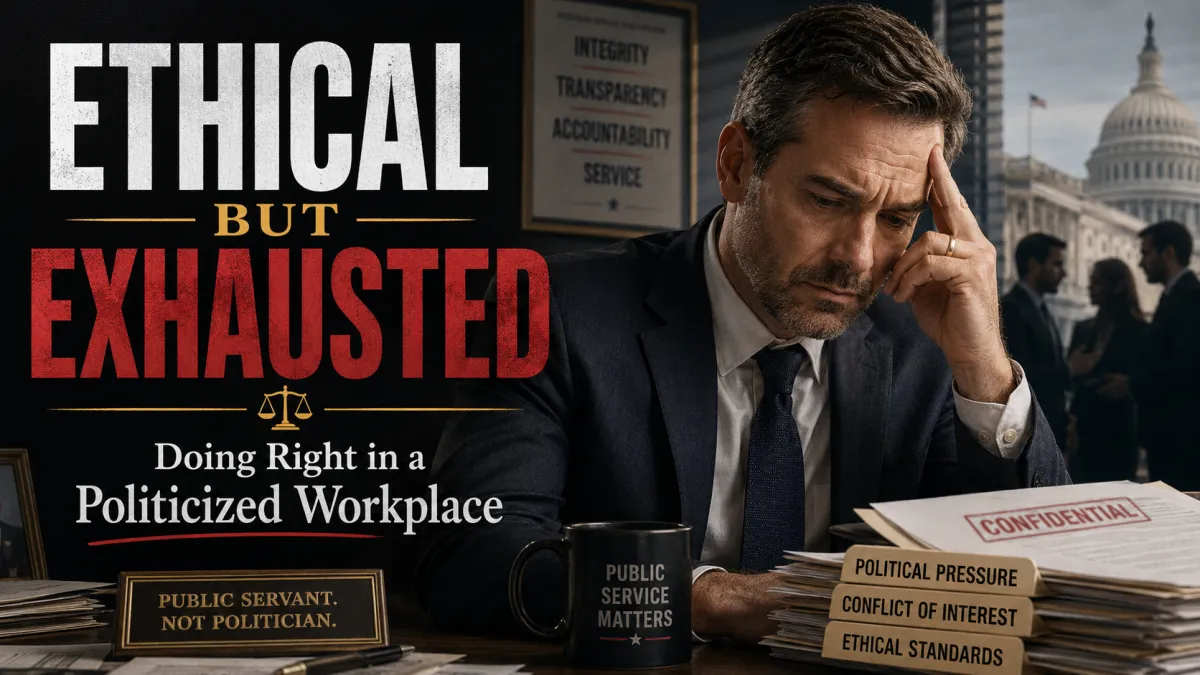
I Am Tired Doing The Right Thing
There is a particular kind of exhaustion that comes from trying to stay ethical in a public-sector workplace where pressure, politics, fear, favoritism, and corruption keep pushing in the opposite direction.
It is not ordinary tiredness and it is not just the fatigue that comes from long hours, heavy workloads, difficult customers, or demanding deadlines.
It is deeper than that. It is the emotional strain that comes from knowing what the right thing is, being expected to do the right thing, and then being pressured, criticized, isolated, or punished because you refused to bend.
This is the hidden burden carried by many professionals in the public sector.
I am talking about HR professionals who are pressured to overlook unfair hiring practices. Accountants who are asked to “adjust” numbers or remain quiet about questionable spending. Engineers who are expected to approve work they know is incomplete, unsafe, or politically convenient. Procurement officers who see favoritism disguised as urgency. Customer service professionals who are verbally abused for applying rules they did not create. Program managers who are expected to support decisions they know will hurt the people they serve. Administrative professionals who see dysfunction but are warned not to “make trouble.”
These are not abstract ethical issues. These are daily emotional realities.
Ethics, at its core, is right conduct. It is the standard of behavior identified by a profession, organization, or public role as appropriate, responsible, and trustworthy. Every profession has some version of this. Lawyers have ethical duties. Psychologists have ethical standards. Medical doctors have codes of conduct. Accountants have rules of integrity and accuracy. Engineers have obligations related to safety, competence, and public welfare. HR professionals are expected to act with fairness and confidentiality. Public servants are expected to serve the public interest, not merely the preferences of the politically powerful.
But in the public sector, ethics can become painfully complicated. That is because public-sector professionals often work at the intersection of law, policy, politics, bureaucracy, public expectation, and human need. They are expected to be neutral, competent, fair, responsive, accountable, ethical and follow civil service and legal guidelines. Yet they may also be surrounded by political pressure, leadership instability, public anger, partisan agendas, favoritism, retaliation, budget constraints, and shifting political priorities related either to corruption or the next election.
Over time, that pressure can become exhausting. The exhaustion comes from the constancy of it. It is not one difficult conversation. It is not one uncomfortable instruction. It is not one unreasonable request. It is the unrelenting nature of being asked, directly or indirectly, to compromise your judgment, your standards, your silence, your fairness, or your professional identity.
Sometimes the pressure is obvious. A supervisor tells you to approve something you know is wrong. A politically connected person expects special treatment. A senior official hints that your career will be easier if you “go along.” A manager asks you not to document a problem. A colleague warns you that raising concerns will damage your future.
Other times, the pressure is subtle. You are excluded from meetings after asking reasonable questions. Your competence is questioned because you refused to rush a decision. You are labeled difficult, disloyal, negative, or “not a team player.” You are treated as the problem because you would not quietly participate in the problem.
That is where professional hurt can begin. Professional hurt is the emotional injury that can occur when workplace experiences begin damaging your confidence, identity, emotional stability, and sense of professional worth. In public-sector settings, professional hurt often occurs when a person is emotionally punished for trying to remain fair, ethical, accurate, lawful, transparent, or responsible.
That kind of hurt can be devastating. You may begin to dread certain meetings. You may rehearse what to say before speaking. You may feel anxious when emails arrive from particular leaders, customers, elected officials, or politically connected individuals. You may start wondering whether doing the right thing is worth the emotional price. You may feel trapped between keeping your job and keeping your integrity.
That is a brutal place to live emotionally.Most professionals cannot simply walk away from their jobs. They have mortgages, families, medical needs, retirement concerns, reputations, and years invested in their careers. So they try to survive. They stay quiet. They comply in small ways. They tell themselves they are choosing their battles. They convince themselves that maybe the issue is not serious enough to risk retaliation.
Sometimes those calculations are necessary. But over time, repeated ethical compromise, forced silence, or constant exposure to corruption can wound the soul of a professional. It can create cynicism, anger, numbness, anxiety, bitterness, insomnia, depression, and a deep loss of professional meaning.
So what can public-sector professionals do?
First, name what is happening. Do not minimize the emotional impact of working in a politically pressured or ethically compromised environment. If you are anxious, exhausted, angry, or losing confidence, those reactions may be signals. They may be telling you that something in your professional environment is violating your values.
Second, document carefully and appropriately. In ethically complex environments, memory is not enough. Keep accurate records where appropriate. Preserve facts, dates, decisions, instructions, and relevant communications in ways that are lawful and consistent with your organization’s policies. Documentation protects clarity. It can also protect you. (And, when you document, keep personal records of your documentation...).
Third, seek wise support before you are in crisis. This may mean speaking with a trusted mentor, HR, an ethics officer, an employee assistance professional, an attorney, a therapist, or an executive coach. Do not wait until the emotional damage is severe. A skilled executive coach can help you think through pressure, boundaries, communication, political realities, leadership dynamics, and the difference between wise restraint and unhealthy silence.
Fourth, strengthen your ethical decision-making under pressure. When politics becomes loud, values must become clearer. Ask yourself: What is my actual duty here? What does policy require? What does my profession require? What would I be willing to explain publicly? What decision allows me to keep my job without losing myself?
Fifth, build emotional resilience deliberately. Resilience is not pretending that the pressure is not real. It is not becoming passive or numb. It is the capacity to stay grounded, thoughtful, and self-respecting while navigating difficult conditions. (take the free Emotional Resilience Assessment for Professionals at www.ProfessionalHurt.com).
Public-sector professionals are often expected to absorb enormous pressure without showing the emotional cost. But ethical exhaustion is real. Professional hurt is real. And the pain of trying to remain principled in a compromised environment should not be ignored.
Yes, the public sector needs professionals who are competent, courageous, emotionally intelligent, and resilient.
But those professionals also need protection, support, coaching, and spaces where they can tell the truth about what this work is costing them.
Why? Because doing the right thing should not require losing yourself in the process.
