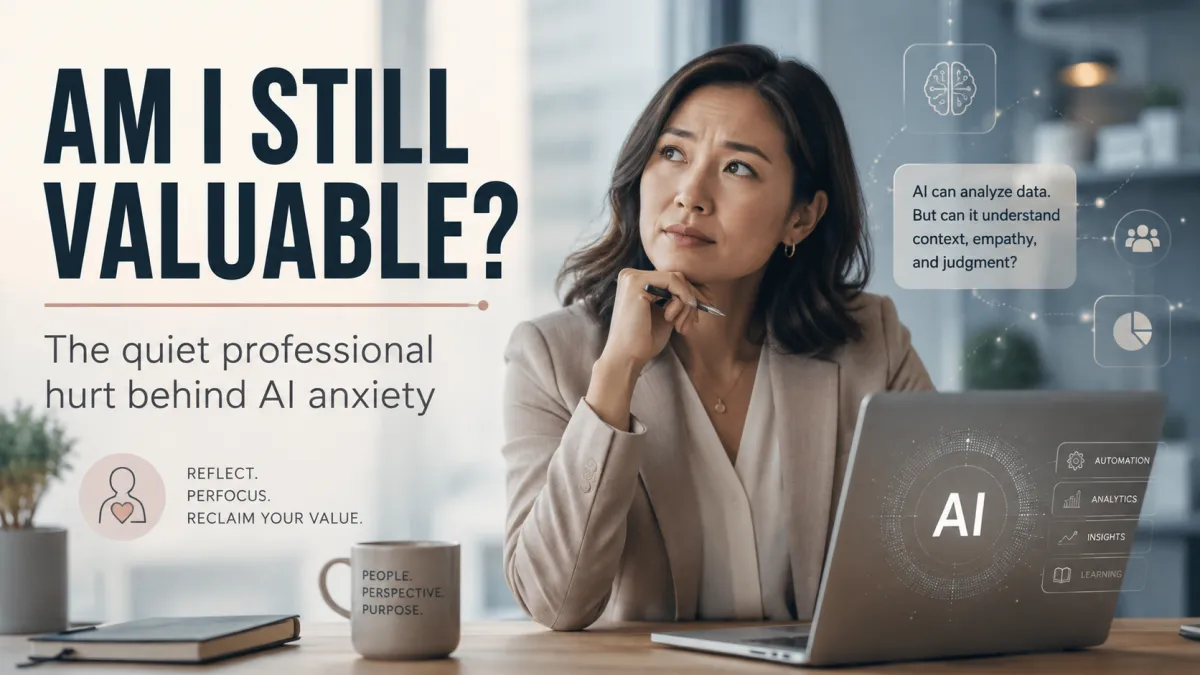
Am I Still Valuable?
Many professionals are not simply afraid of artificial intelligence. They are afraid of becoming invisible. They are afraid that the skills they spent years developing may suddenly be seen as outdated. They are afraid that their experience may no longer matter. They are afraid that younger colleagues who seem more comfortable with technology will move ahead while they quietly fall behind. They are afraid that one day a leader, consultant, software platform, or budget committee will decide that what they do can be done faster, cheaper, or “better” by AI.
Underneath all the talk about innovation, productivity, disruption, and efficiency, there is a very human question many professionals are carrying silently:
“Am I still valuable?”
That question is not just technical. It is emotional. It is psychological. It is professional. And if it is not handled wisely, it can become another source of professional hurt.
Professional hurt occurs when workplace experiences begin damaging a person’s confidence, identity, emotional stability, and sense of professional worth. In the past, that hurt may have come from a toxic manager, emotional abuse, public humiliation, exclusion, betrayal, or unfair criticism. Today, for many professionals, it is also coming from a new kind of pressure: the fear of becoming professionally irrelevant in a workplace that is changing faster than their confidence can keep up.
I want to be clear. AI itself is not the enemy.
Technology has always changed work. Tools change. Systems change. Expectations change. Industries evolve. Professionals have always had to learn, adapt, and grow. That is part of working life.
But what is different now is the speed, the global scope, intensity, and emotional impact of the change.
Many professionals are being told to “adapt” without being given meaningful training. They are being told to “use AI” without being given clear guidance on how, when, where, or why. They are hearing leaders talk about automation, efficiency, headcount reduction, productivity gains, and future readiness, while wondering quietly whether they are being prepared for the future or pushed toward the exit.
In addition, they are told that sometimes it’s proper to use AI, other times it may be improper and unethical… and possibly illegal.
Those kinds of uncertainty and lack of clarity can wound people.
When human beings do not know where they stand, they begin filling in the blanks with fear. Professionals begin wondering whether their work is still respected. They question whether their judgment is still needed. They are concerned that the organization may see them as an expense rather than an asset. And they also worry that their work… sometime in the near or not so distant future may be seen as plagiarism, borrowed or bear a negative taint of being ‘AI generated’ work.
That is when their anxiety increases and deepens.
I have worked with professionals who were not afraid to learn. They were willing to grow. They were willing to explore new tools. But they were deeply hurt by the way change was introduced. They felt dismissed, rushed, shamed, or made to feel foolish because they were not immediately fluent in the latest technology (or because they used it as instructed).
That is not leadership. That is carelessness. An emotionally intelligent workplace does not simply throw people into disruption and then tell them to cope. It helps people understand what is changing, why it matters, what support is available, and how their existing strengths still matter in the new environment. And, it helps them to carefully navigate the areas which are currently murky and gray…
A professional who has spent twenty years developing keen judgment, effective relationship skills, ethical reasoning strategies, institutional knowledge sets, emotional intelligence competencies, deep customer insights, problem-solving abilities, and leadership presence does not become worthless because a new software tool appears.
That person may need new skills. But they do not need to be treated as obsolete.
This distinction is important because one of the most damaging effects of AI anxiety is identity confusion. Many professionals do not just think, “I need to learn a new tool.” They begin thinking, “Maybe I am no longer enough.”
That is where professional hurt can enter the picture.
A person can recover from a skills gap much more easily than from a wound to their sense of worth. If someone believes they simply need training, they can learn. But if they begin believing they are outdated, replaceable, or professionally diminished, the emotional consequences can be much deeper.
They may withdraw. They may stop speaking up. They may avoid opportunities. They may feel embarrassed to ask questions. They may pretend to understand things they do not understand. They may resent younger colleagues. They may become defensive when AI is discussed. They may lose confidence in abilities that are still highly valuable.
That is why today’s leaders must be careful.
The future of work cannot be built by humiliating the very people who helped build the present organization. Leaders who are serious about transformation must strategically combine technology adoption with emotional intelligence. They must communicate clearly, train patiently, listen honestly, and reassure people that adaptation does not mean erasure.
They must say, not just with words but through action, “You still matter here. Your experience still matters. Your judgment still matters. Your humanity still matters. Now let us help you add new tools to the strengths you already possess.”
That is leadership at its best.
For professionals who are feeling anxious, I would offer this guidance. Do not let fear drive you into silence. Begin learning, but do not panic-learn. Identify the AI tools that are actually relevant to your work… but don’t try to use every tool that appears online. Ask for training. Seek coaching. Find trusted colleagues with whom you can learn without hesitancy or feeling shame. Experiment in small ways. Build competence gradually.
At the same time, do not reduce your value to just your technical (AI related) speed at getting things done.
Your value is not only in what you can produce quickly. It is also in how you think, how you judge, how you relate, how you lead, how you solve problems, how you handle complexity, and how you bring wisdom (from experience) to situations that technology cannot fully understand.
AI may assist work. But it cannot replace emotional maturity, ethical judgment, trust-building, lived experience, courage, compassion, and the deeply human ability to understand another person’s pain, fear, hope, and potential.
That is why resilience matters.
Resilience does not mean pretending that AI anxiety is irrational. It is not irrational. The workplace is changing, and some jobs will change dramatically. Resilience means facing that reality without allowing fear to destroy your confidence before changes even fully arrive.
Resilience means asking, “What do I need to learn?” without also concluding, “I am no longer valuable.”
One way to begin is through honest self-assessment. The Emotional Resilience Assessment for Professionals™ can help you reflect on how workplace pressure, professional hurt, stress, and emotional uncertainty may be affecting your confidence, resilience, and wellbeing. Sometimes people do not need someone to tell them they are broken. They need language for what they have been feeling and direction for what to strengthen next.
If AI has left you anxious, unsettled, or unsure of your professional future, do not ignore that emotional signal. Learn what you need to learn. Get the support you need. Strengthen your resilience. Protect your confidence.
And remember this clearly: You may need to update your skills. But you do not need to surrender your worth.
