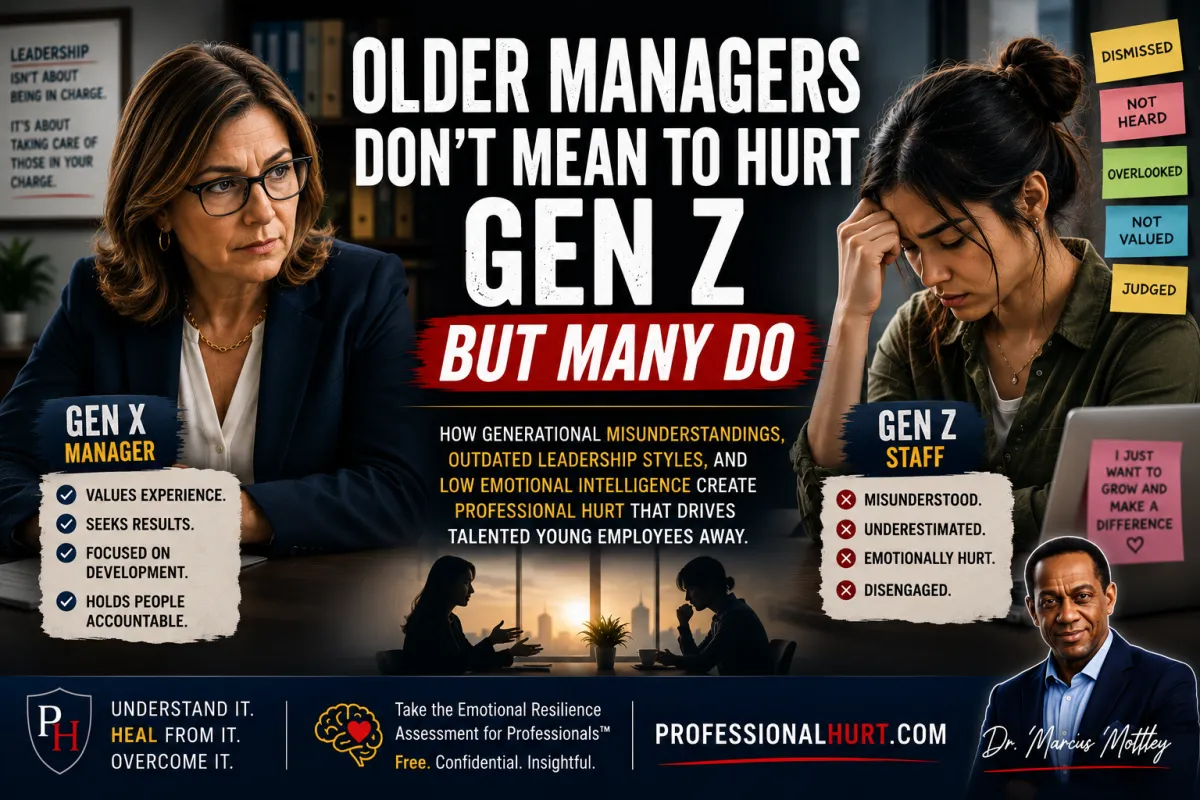
Older Managers Don't Mean to Hurt Gen Z… But Many Do
Every generation enters the workforce with different expectations, communication styles, and life experiences. Today's Gen Z professionals are no exception. They have grown up in a world of constant connectivity, rapid technological change, heightened awareness of mental health, and an expectation that work should provide not only a paycheck but also purpose, growth, and respect.
Unfortunately, many older managers misunderstand these expectations.
The result is not simply generational conflict. It is often something much deeper: professional hurt.
As a clinical psychologist and executive coach, I have worked with professionals across multiple generations. One observation has become increasingly clear. Most older managers are not intentionally trying to damage younger employees. In fact, many genuinely care about developing their staff. Yet despite these good intentions, outdated leadership approaches, poor communication habits, and limited emotional intelligence can unintentionally leave Gen Z employees emotionally wounded, disengaged, and searching for another employer.
The greatest leadership failures are often not failures of intention. They are failures of awareness.
The Professional Hurt That Older Managers Never See
Professional hurt occurs when repeated workplace experiences leave lasting emotional wounds that affect a person's confidence, motivation, relationships, resilience, and performance.
For many Gen Z employees, these wounds rarely begin with one major incident. Instead, they develop through a series of smaller interactions.
Being publicly criticized rather than coached.
Having ideas dismissed because they are "too young."
Being told to "toughen up."
Receiving little feedback except when something goes wrong.
Feeling ignored, excluded, or constantly compared to older employees.
Being expected to "pay your dues" without receiving meaningful guidance or mentorship.
Individually, these experiences may appear insignificant. Repeated over months or years, however, they can fundamentally change how a young professional sees both work and themselves.
Eventually, enthusiasm becomes anxiety, confidence becomes self-doubt and engagement becomes emotional withdrawal.
The Generational Blind Spot
Many Baby Boomers and Generation X managers built successful careers in workplaces where hierarchy was respected, authority was rarely questioned, and emotional struggles were often hidden.
For many of them, difficult supervisors were considered part of professional life.
"You'll get over it."
"That's just how work is."
"We all went through it."
These statements are rarely intended to cause harm.
Yet they often invalidate the emotional experiences of younger employees.
Gen Z is sometimes criticized for being overly sensitive. While resilience certainly remains an important workplace skill, many organizations fail to distinguish between healthy resilience and repeated emotional injury.
Resilience is adapting to difficult situations.
Professional hurt is what happens when emotionally unhealthy environments become normal.
That distinction is significant and matters greatly.
Emotional Intelligence Changes Everything
The most effective managers today are not simply knowledgeable. They are emotionally intelligent. They recognize that leadership is less about exercising authority and more about building trust.
Yet… emotionally intelligent leaders ask questions before making assumptions. They seek to understand before they correct. They coach before they criticize. They provide feedback that develops confidence rather than destroys it.
Most importantly, they recognize that the emotional climate they create directly influences employee engagement, innovation, retention, and organizational culture.
Research consistently demonstrates that employees leave managers far more often than they leave organizations.
For Gen Z, this is especially true.
When younger employees feel psychologically safe, respected, and supported, they frequently become some of the organization's most innovative and loyal contributors.
What Older Managers Can Do Differently
Fortunately, preventing professional hurt does not require becoming a completely different leader.
Small changes often produce remarkable results.
Replace assumptions with curiosity.
Provide coaching instead of public correction.
Explain the "why" behind decisions.
Recognize effort as well as outcomes.
Invite ideas from younger employees.
Hold people accountable without attacking their dignity.
Most importantly, remember that respect is not weakness. Instead, it is one of leadership's greatest strengths.
A Message for Gen Z Professionals
If you are a young professional experiencing repeated criticism, disrespect, emotional exhaustion, or constant self-doubt because of your work environment, do not immediately conclude that something is wrong with you.
Sometimes the problem is not your ability… because sometimes it is the leadership environment around you.
That does not mean every difficult manager is emotionally abusive, nor does it mean every disagreement is professional hurt. However, if negative workplace experiences continue affecting your confidence, motivation, emotional well-being, or even your relationships outside of work, those experiences deserve serious attention… and action!
Recognizing professional hurt is not about assigning blame. It is about understanding what has happened so that healing and growth can begin.
The First Step Toward Recovery
Whether you are a young professional trying to understand your emotional reactions at work or a leader wanting to build a healthier workplace, awareness is always the first step.
One practical way to begin is by completing the Emotional Resilience Assessment for Professionals™, available free at ProfessionalHurt.com. The assessment helps identify how past workplace experiences may still be affecting your confidence, decision-making, relationships, and also measures your level of emotional resilience under pressure. It also provides valuable insight into whether professional hurt may be influencing how you experience work today.
The future of leadership will not belong to those who simply have the most experience.
It will belong to those who understand people.
When older managers combine their years of wisdom with emotional intelligence, coaching skills, and genuine curiosity about younger generations, something remarkable happens: Professional hurt decreases. Trust grows. Generations learn from one another. And the future leaders become teachable mentees and coachees of current leaders.
And workplaces become places where every employee, not just the most experienced, has the opportunity to thrive.
