
Professional Hurt, Emotional Intelligence
& Resilience Knowledge Hub
Articles and insights from Dr. Marcus Mottley on professional hurt, emotional intelligence, workplace emotional abuse, toxic leadership, emotional resilience, and recovery for professionals. Professional hurt is the emotional and psychological injury caused by toxic leadership, chronic invalidation, humiliation, betrayal, workplace emotional abuse, and organizational harm.
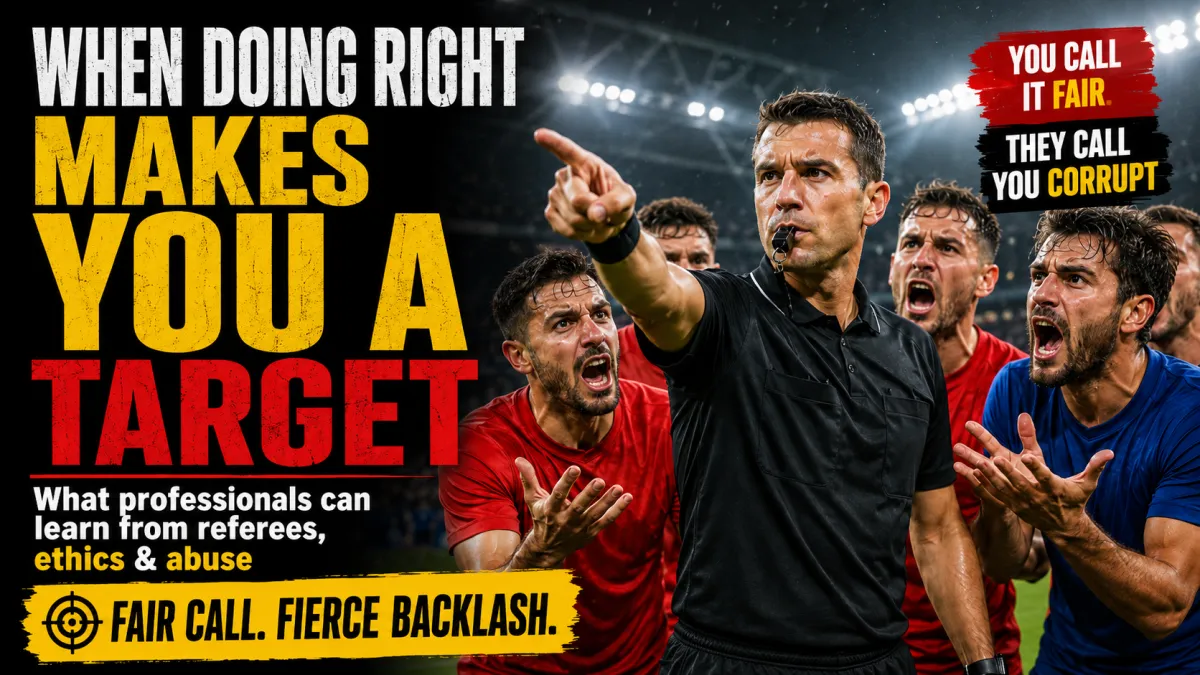
Those 'Awful' World Cup Referees
One of the striking lessons from the recent World Cup has nothing to do with goals, tactics, players, managers, formations, or wins and losses. It has to do with the emotional cost of making decisions under pressure while millions of people question your competence, your motives, and your integrity.
I am talking about the referees.
During major sporting events, referees make split-second decisions in highly charged environments. Some calls are correct. Some are questionable. Some may be wrong. That is the nature of human judgment under pressure. But what has become deeply troubling is the level of online abuse directed at referees, with people not only criticizing their decisions, but questioning their impartiality, attacking their character, and assuming corrupt motives.
FIFA has publicly reported significant levels of online abuse during the 2026 World Cup, including abusive social media posts identified through its Social Media Protection Service. It has also been reported that at least 89,000 abusive posts were identified during the group stage alone, a major increase from the previous men’s World Cup. That reality should concern anyone who cares about human dignity, fairness, and emotional wellbeing.
It is one thing to disagree with a decision.
It is another thing to abuse the person who made it.
That distinction matters far beyond football.
Many professionals face a similar kind of emotional punishment when they try to do the right thing at work. They may not be referees on a field, but they are expected to make ethical decisions in emotionally charged environments where customers, colleagues, supervisors, or managers may not like the outcome.
A human resources professional enforces a policy and is accused of being heartless. A compliance officer refuses to approve a questionable transaction and is labeled difficult. An elections officer makes ordinary decisions and is publicly vilified as being corrupt. A healthcare worker follows proper procedure and is verbally attacked by a patient or family member. A manager gives honest feedback and is accused of being unfair. A public servant applies the rules consistently and is treated as if they personally created the problem.
In these moments, the professional is not being abused because they did something unethical. They are often being attacked because they tried to be ethical.
That is a painful reality.
Ethical professionals are sometimes punished not for being wrong, but for refusing to bend. They are hurt because they tell the truth, enforce standards, protect boundaries, follow the rules, or make common-sense decisions that others do not want to accept.
This is one area where professional hurt can occur.
Professional hurt is the emotional injury that can occur when workplace experiences begin damaging a person’s confidence, identity, emotional stability, and sense of professional worth. It often emerges when people are criticized, humiliated, accused, manipulated, bullied, or emotionally abused while simply trying to do the jobs that they are qualified and certified to do and are experienced at effectively executing.
Over time, these experiences of being abused can take a heavy toll. Professionals may begin dreading certain customers, meetings, emails, or conversations. They may replay interactions long after work ends. They may wonder whether they should have stayed silent, avoided conflict, or, in the case of the referees, not called those egregious fouls and instead compromised their values just to protect their inner peace. (In many cases, they would have been abused anyway!)
Compromising one's values... That is one of the most dangerous effects of repeated abuse.
It can make ethical people question whether integrity is worth the pain.
As a clinical psychologist and executive coach, I want to say this clearly: if you were mistreated because you acted ethically, that mistreatment does not mean you were wrong. It means someone else may have been unwilling to accept accountability, boundaries, consequences, or truth.
The challenge is that professionals must learn how to hold onto their integrity without allowing abuse to destroy their emotional health.
That requires emotional resilience.
Resilience is not becoming cold, hard, detached, or indifferent. It is not pretending that verbal abuse, unfair accusations, public embarrassment, or character attacks do not hurt. Resilience is the ability to stay grounded in who you are, even when others try to define you through their anger.
Professionals need to learn how to separate criticism from truth. They need to ask, “Was there something useful in the feedback, or was this simply an emotional attack?” They need to document abusive patterns, seek support, use appropriate reporting channels, and refuse to internalize every accusation made by people who are upset with a decision.
They also need organizations that protect ethical behavior.
It is not enough to tell professionals to “be resilient” while leaving them exposed to repeated abuse. Leaders must create cultures where people are supported when they make principled decisions. Staff should not be sacrificed emotionally because a customer is angry, a colleague is retaliatory, or a manager dislikes accountability.
The World Cup reminds us that decision-makers are often criticized most harshly when the stakes are high. But it should also remind us that people can disagree without dehumanizing the person who made the decision.
Professionals in your office need that same protection.
If you have been emotionally hurt because you tried to be fair, ethical, honest, or principled at work, do not confuse someone else’s reaction with your worth. Their anger may be loud, but it does not have to become your identity.
The real task is not to abandon your ethics.
The real task is to strengthen your resilience, protect your wellbeing, and remember that doing the right thing should never require you to silently absorb emotional abuse.
If you want to assess your levels of hurt and/or resiliency, go to www.ProfesionalHurt.com
FAQ
Frequently Asked Questions About Professional Hurt, Emotional Intelligence, and Emotional Resilience.
1. What is Professional Hurt?
Professional Hurt is the emotional, psychological, and often career-related injury that can occur when professionals experience toxic leadership, workplace emotional abuse, chronic invalidation, humiliation, betrayal, intimidation, exclusion, or organizational harm. Unlike ordinary workplace stress, Professional Hurt can continue affecting a person’s confidence, identity, motivation, relationships, and emotional well-being long after the original experience has ended.
2. How is Professional Hurt different from burnout?
Burnout usually comes from chronic stress, overwork, emotional exhaustion, and prolonged demands. Professional Hurt goes deeper. It often involves emotional injury caused by toxic relationships, betrayal, humiliation, bullying, invalidation, or abusive leadership. A burned-out professional may feel depleted. A professionally hurt person may feel wounded, betrayed, diminished, and unsure of themselves.
3. Can toxic leadership cause Professional Hurt?
Yes. Toxic leadership can cause Professional Hurt when leaders use intimidation, public criticism, manipulation, favoritism, emotional invalidation, threats, exclusion, or control tactics instead of emotionally intelligent leadership. Over time, these behaviors can damage trust, confidence, motivation, and psychological safety.
4. Can Professional Hurt affect emotional health?
Yes. Professional Hurt can contribute to anxiety, depression, rumination, sleep problems, emotional exhaustion, loss of confidence, irritability, isolation, and difficulty trusting others. Some professionals continue replaying painful workplace experiences long after they have left the environment because the emotional injury has not yet been fully processed or healed.
5. Why do some professionals suffer in silence?
Many professionals suffer in silence because they fear being judged, labeled as weak, viewed as too sensitive, or punished for speaking up. High-achieving professionals may also minimize their pain because they are used to performing under pressure. Unfortunately, silence often allows the emotional injury to deepen.
6. What role does Emotional Intelligence play in preventing Professional Hurt?
Emotional Intelligence helps leaders recognize the emotional impact of their words, decisions, power, and behavior. Leaders with strong emotional intelligence are more likely to communicate respectfully, manage conflict constructively, repair harm, build trust, and create psychologically safer workplaces. Poor emotional intelligence often increases the risk of emotional damage.
7. How does Emotional Resilience help professionals recover?
Emotional Resilience helps professionals regain stability, perspective, confidence, and emotional strength after difficult workplace experiences. It does not mean pretending the hurt did not happen. It means learning how to process the experience, protect your emotional health, rebuild your sense of self, and move forward without allowing the pain to define your future.
8. How do I know if I have experienced Professional Hurt?
You may have experienced Professional Hurt if a workplace experience continues to affect your confidence, mood, motivation, sleep, relationships, or sense of professional identity. Signs may include replaying painful conversations, dreading work, feeling emotionally unsafe, questioning your competence, feeling betrayed, or struggling to recover from how you were treated.
9. Can leaders repair Professional Hurt after damage has been done?
In some cases, yes. Repair requires honesty, accountability, humility, changed behavior, and emotionally intelligent communication. Leaders must stop minimizing the harm, listen without defensiveness, acknowledge the emotional impact, and create conditions where trust can be rebuilt. However, repair is not possible if harmful behavior continues or accountability is avoided.
10. How can Dr. Marcus Mottley’s work help professionals dealing with Professional Hurt?
Dr. Marcus M. Mottley, brings together clinical psychology, executive coaching, emotional intelligence, leadership development, and resilience training to help professionals understand, assess, and recover from Professional Hurt. His work focuses on helping professionals make sense of workplace emotional injury, rebuild confidence, strengthen resilience, and move forward with greater emotional clarity and professional power.