
Professional Hurt, Emotional Intelligence
& Resilience Knowledge Hub
Articles and insights from Dr. Marcus Mottley on professional hurt, emotional intelligence, workplace emotional abuse, toxic leadership, emotional resilience, and recovery for professionals. Professional hurt is the emotional and psychological injury caused by toxic leadership, chronic invalidation, humiliation, betrayal, workplace emotional abuse, and organizational harm.
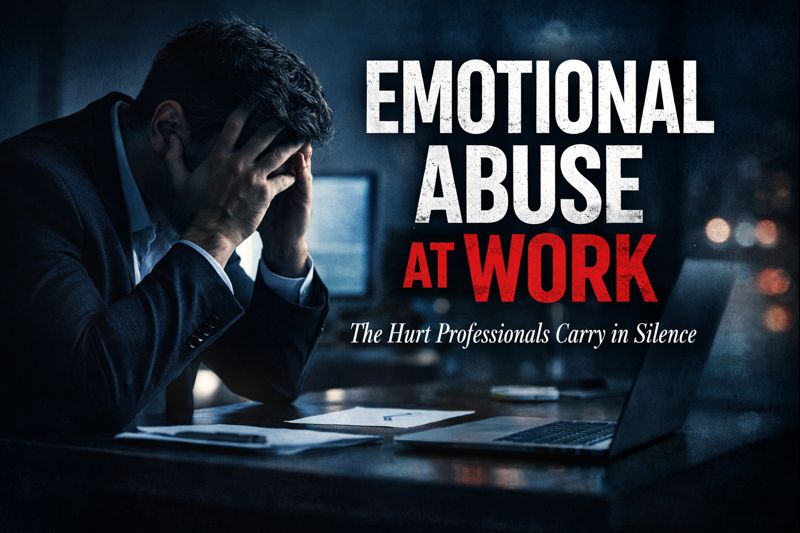
The Emotional Abuse Professionals Carry In Silence
There is a form of suffering that rarely makes headlines, is seldom reported to HR, and almost never shows up in performance reviews. Yet it quietly reshapes careers, identities, and lives. I am referring to emotional abuse in the workplace. It is also called professional hurt.
After decades of working as both a Clinical Psychologist and an Executive Coach, I can state this plainly. Emotional abuse at work is widespread, deeply normalized, and profoundly underestimated. Professional hurt affects professionals across industries, across levels of seniority, and across both public and private sectors. What troubles me most is not only how common this abuse is, but how rarely it is acknowledged and how often the resulting emotional injuries are carried for an entire professional lifetime.
Many professionals never name what happened to them as abuse. They describe it instead as “a bad boss,” “a tough environment,” “politics,” or “just the way things are.” Others internalize it, assuming they were weak, overly sensitive, or somehow deserving of the treatment. As a result, this kind of hurt that occurs on the job goes unreported, untreated, and unresolved.
I have sat with professionals who were publicly humiliated in meetings, repeatedly undermined by supervisors, scapegoated for systemic failures, excluded from critical conversations, or subjected to chronic intimidation disguised as “high standards.” I have worked with individuals whose competence was questioned relentlessly, whose reputations were quietly eroded, and whose confidence was dismantled over time, not through one dramatic event, but through a steady drip of contempt, gaslighting, and psychological pressure.
One senior public-sector administrator came to me years after leaving her role. Her voice still tightened when she spoke about a supervisor who regularly mocked her in front of staff, dismissed her expertise, and subtly encouraged others to treat her with disdain. No formal complaint was ever filed. She told herself she needed to “be professional” and endure. Long after the job ended, the emotional imprint remained. She questioned herself in every new leadership role.
In the private sector, I worked with a highly skilled technology professional whose manager alternated between praise and sudden, unexplained hostility. Expectations shifted without warning. Feedback was vague but punitive. When projects failed, blame was personalized. When they succeeded, credit was withheld. The client eventually left the organization, outwardly intact, yet inwardly carrying a deep mistrust of authority and a persistent fear of being blindsided again.
On the job emotional abuse and the hurt it carries does not only come from bosses. I have worked with frontline professionals who were verbally attacked, demeaned, and threatened by customers or clients, often with little organizational protection. Nurses, social workers, customer service managers, inspectors, and administrators in both government and corporate roles are routinely expected to absorb mistreatment as “part of the job.” Over time, this erodes emotional safety and personal dignity.
What makes this form of harm particularly insidious is that it rarely leaves visible evidence. There are no bruises, no clear incident reports, no single event that can be neatly documented. Instead, there is cumulative damage. Confidence shrinks. Motivation fades. Sleep is disrupted. Self-doubt becomes chronic. Professionals begin to second-guess themselves, not only at work but at home, in relationships, and in their sense of self.
I have seen how unresolved professional hurt bleeds into personal lives. Individuals become emotionally withdrawn with partners, short-tempered with children, or perpetually on edge. Some lose their sense of purpose. Others carry a quiet bitterness or grief they cannot fully explain. Many adapt by becoming hypervigilant, emotionally armored, or disengaged, strategies that may protect them temporarily but exact a long-term cost.
What is especially painful is how alone many professionals feel with this experience. High-achieving individuals often believe they should be able to “handle it.” Admitting hurt can feel like admitting weakness. In cultures that reward endurance and silence, suffering becomes invisible.
And yet, I want to be clear about something essential. Emotional injuries sustained at work are real. They matter. And they do not have to be permanent sentences of emotional pain.
I have worked with professionals who believed their careers were irreparably damaged, who felt broken by what they endured, and who assumed they would never fully recover their confidence or sense of agency. I have seen those same individuals regain clarity, reclaim their professional identities, and move forward with renewed strength and discernment. Recovery is possible. Not by pretending the hurt did not happen, and not by simply “moving on,” but by acknowledging the impact and addressing it with seriousness and care.
The tragedy is not only that emotional abuse occurs at work. The greater tragedy is that so many professionals carry these wounds alone, often for decades, believing they must endure in silence.
They do not have to. Help is available.
I have devoted much of my professional life to helping individuals understand what happened to them, make sense of its impact, and re-enter their professional lives without being defined by past harm. The first step is not fixing or reframing or powering through. It is recognizing that what was experienced was real, consequential, and worthy of attention.
Emotional abuse in the workplace and the hurt it causes is not rare. It is not trivial. And it does not have to shape the rest of a person’s career or life. But it does require acknowledgment, support, and skilled help.
Too many professionals suffer quietly. My work exists because they no longer have to.

FAQ
Frequently Asked Questions About Professional Hurt, Emotional Intelligence, and Emotional Resilience.
1. What is Professional Hurt?
Professional Hurt is the emotional, psychological, and often career-related injury that can occur when professionals experience toxic leadership, workplace emotional abuse, chronic invalidation, humiliation, betrayal, intimidation, exclusion, or organizational harm. Unlike ordinary workplace stress, Professional Hurt can continue affecting a person’s confidence, identity, motivation, relationships, and emotional well-being long after the original experience has ended.
2. How is Professional Hurt different from burnout?
Burnout usually comes from chronic stress, overwork, emotional exhaustion, and prolonged demands. Professional Hurt goes deeper. It often involves emotional injury caused by toxic relationships, betrayal, humiliation, bullying, invalidation, or abusive leadership. A burned-out professional may feel depleted. A professionally hurt person may feel wounded, betrayed, diminished, and unsure of themselves.
3. Can toxic leadership cause Professional Hurt?
Yes. Toxic leadership can cause Professional Hurt when leaders use intimidation, public criticism, manipulation, favoritism, emotional invalidation, threats, exclusion, or control tactics instead of emotionally intelligent leadership. Over time, these behaviors can damage trust, confidence, motivation, and psychological safety.
4. Can Professional Hurt affect emotional health?
Yes. Professional Hurt can contribute to anxiety, depression, rumination, sleep problems, emotional exhaustion, loss of confidence, irritability, isolation, and difficulty trusting others. Some professionals continue replaying painful workplace experiences long after they have left the environment because the emotional injury has not yet been fully processed or healed.
5. Why do some professionals suffer in silence?
Many professionals suffer in silence because they fear being judged, labeled as weak, viewed as too sensitive, or punished for speaking up. High-achieving professionals may also minimize their pain because they are used to performing under pressure. Unfortunately, silence often allows the emotional injury to deepen.
6. What role does Emotional Intelligence play in preventing Professional Hurt?
Emotional Intelligence helps leaders recognize the emotional impact of their words, decisions, power, and behavior. Leaders with strong emotional intelligence are more likely to communicate respectfully, manage conflict constructively, repair harm, build trust, and create psychologically safer workplaces. Poor emotional intelligence often increases the risk of emotional damage.
7. How does Emotional Resilience help professionals recover?
Emotional Resilience helps professionals regain stability, perspective, confidence, and emotional strength after difficult workplace experiences. It does not mean pretending the hurt did not happen. It means learning how to process the experience, protect your emotional health, rebuild your sense of self, and move forward without allowing the pain to define your future.
8. How do I know if I have experienced Professional Hurt?
You may have experienced Professional Hurt if a workplace experience continues to affect your confidence, mood, motivation, sleep, relationships, or sense of professional identity. Signs may include replaying painful conversations, dreading work, feeling emotionally unsafe, questioning your competence, feeling betrayed, or struggling to recover from how you were treated.
9. Can leaders repair Professional Hurt after damage has been done?
In some cases, yes. Repair requires honesty, accountability, humility, changed behavior, and emotionally intelligent communication. Leaders must stop minimizing the harm, listen without defensiveness, acknowledge the emotional impact, and create conditions where trust can be rebuilt. However, repair is not possible if harmful behavior continues or accountability is avoided.
10. How can Dr. Marcus Mottley’s work help professionals dealing with Professional Hurt?
Dr. Marcus M. Mottley, brings together clinical psychology, executive coaching, emotional intelligence, leadership development, and resilience training to help professionals understand, assess, and recover from Professional Hurt. His work focuses on helping professionals make sense of workplace emotional injury, rebuild confidence, strengthen resilience, and move forward with greater emotional clarity and professional power.