
Professional Hurt, Emotional Intelligence
& Resilience Knowledge Hub
Articles and insights from Dr. Marcus Mottley on professional hurt, emotional intelligence, workplace emotional abuse, toxic leadership, emotional resilience, and recovery for professionals. Professional hurt is the emotional and psychological injury caused by toxic leadership, chronic invalidation, humiliation, betrayal, workplace emotional abuse, and organizational harm.
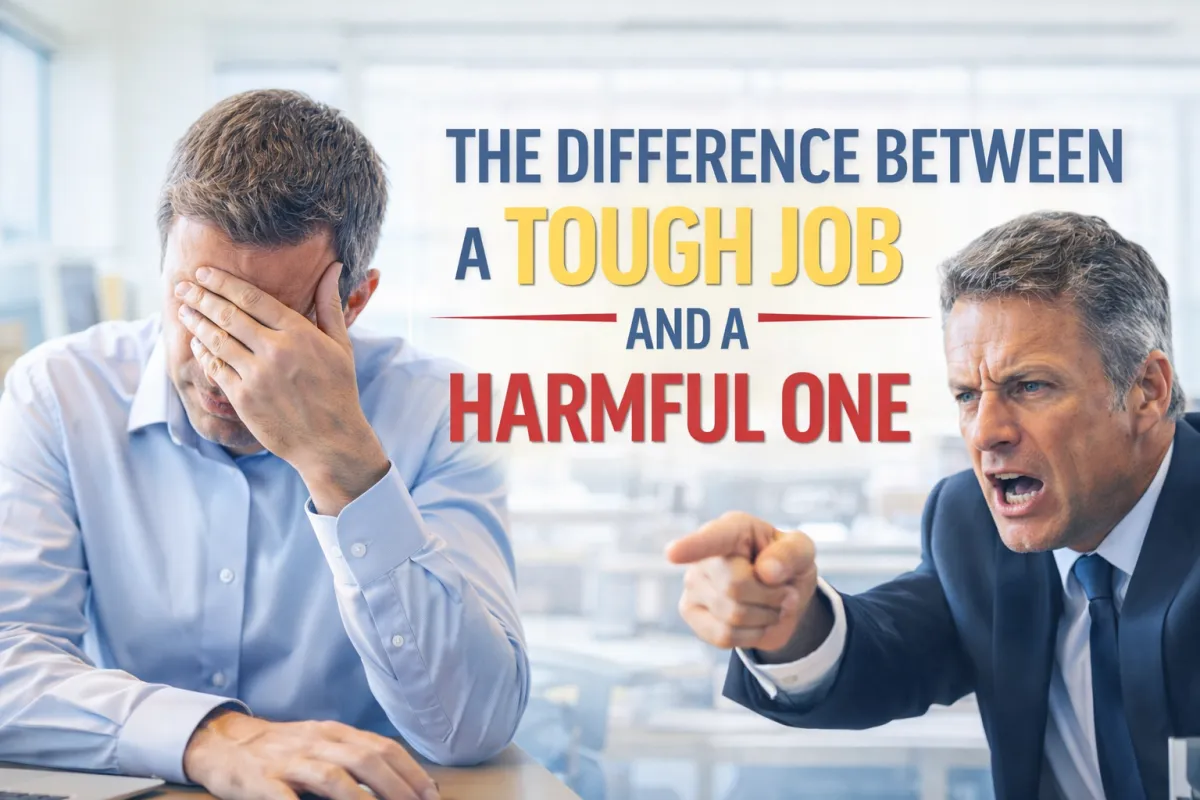
The Difference Between a Tough Job and a Harmful One
Your job may not be very difficult… but it may be a harmful one.
That may sound obvious, but in my experience, it is one of the most important distinctions a professional can learn to make. Because when everything feels hard, it becomes easy to assume that something is wrong… or just as easily, to assume that nothing is.
You tell yourself, “This is just part of the job.”Or, “Maybe I just need to be stronger.”
And sometimes, that’s true.
But sometimes, it isn’t.
A tough job stretches you. A harmful one diminishes you.
A tough job demands more of your skills, your focus, your discipline. It challenges you, sometimes relentlessly. You may feel tired, even overwhelmed at times, but there is still a sense, however faint, that you are growing… that you are becoming more capable, more refined, more resilient.
A harmful job, on the other hand, does something different.
It does not just demand from you. It takes from you.
It takes your confidence.
It takes your clarity.
It takes your sense of stability.
And over time, if you are not careful, it begins to take your sense of self.
The difficulty is that, on the surface, both can feel similar. Long hours. High expectations. Pressure. Critical feedback. Fast-paced environments. Strong personalities. All of these can exist in both tough and harmful workplaces.
So how do you tell the difference?
This is where discernment becomes essential.
Not accusation. Not blame. Not overreaction.
Discernment.
Let me offer you a way to begin making that distinction.
The Internal Signal Test
Instead of focusing only on what is happening around you, begin to observe what is happening within you over time.
Ask yourself:
After sustained exposure to this environment, am I becoming stronger or smaller?
Am I more confident in my abilities… or more doubtful of them?
Do I feel challenged… or do I feel diminished?
A tough job may exhaust you, but it does not erode your core sense of competence. In fact, when you step back, you can often see evidence of growth.
A harmful job creates a different internal pattern. You may notice hesitation where there was once confidence. Silence where there was once expression. Self-questioning where there was once clarity.
That is not growth.
That is impact.
Another important distinction lies in how feedback and pressure are delivered.
In a tough but healthy environment, feedback, even when direct, is anchored in development. You may not always like it, but you can see how it connects to improvement. There is a sense of direction.
In a harmful environment, feedback often feels inconsistent, personal, or destabilizing. It leaves you unsure of where you stand. You may find yourself trying to “read the room” rather than focus on your work.
Over time, this creates a quiet form of emotional strain that is difficult to explain, but impossible to ignore.
I have worked with professionals across many industries who struggled with this exact confusion. They were high performers, capable, driven… yet unsure whether what they were experiencing was simply “tough” or something more.
What they often discovered, once they slowed down enough to reflect, was that their internal experience had been giving them signals all along.
They just hadn’t trusted them.
A Practical Strategy: The Pattern Journal
If you want to develop sharper discernment, I often suggest a simple but powerful technique.
For two weeks, keep can be called a pattern journal.
At the end of each workday, take just a few minutes and write down:
One interaction that energized or strengthened you
One interaction that drained or unsettled you
How you felt about yourself at the end of the day
Do not overanalyze. Just record.
At the end of the two weeks, review what you have written.
Patterns will begin to emerge.
You may notice that certain environments, people, or situations consistently challenge you in a way that builds you. Or you may notice repeated experiences that leave you feeling smaller, uncertain, or emotionally depleted.
This is not about labeling your workplace as “good” or “bad.” It is about understanding your experience with clarity.
Because without clarity, you either tolerate harm… or misinterpret growth.
Neither serves you.
There is a broader conversation here that I have been exploring more deeply, particularly around what I refer to as Professional Hurt… the emotional impact that harmful work experiences can leave behind. It is a subject I will be addressing more fully in my forthcoming book, Healing from Professional Hurt: Overcoming Emotional Trauma from On-the-Job Abuse.
If this distinction between tough and harmful resonates with you, you may find additional insights at www.professionalhurt.com, where I continue to explore these ideas in a practical and grounded way.
For now, I would leave you with this:
Not every hard experience is harmful. But not every harmful experience looks extreme.
Your task is not to judge too quickly. It is to see clearly.
Because once you can distinguish between what is building you… and what is breaking you… you begin to regain something very important: Choice.

FAQ
Frequently Asked Questions About Professional Hurt, Emotional Intelligence, and Emotional Resilience.
1. What is Professional Hurt?
Professional Hurt is the emotional, psychological, and often career-related injury that can occur when professionals experience toxic leadership, workplace emotional abuse, chronic invalidation, humiliation, betrayal, intimidation, exclusion, or organizational harm. Unlike ordinary workplace stress, Professional Hurt can continue affecting a person’s confidence, identity, motivation, relationships, and emotional well-being long after the original experience has ended.
2. How is Professional Hurt different from burnout?
Burnout usually comes from chronic stress, overwork, emotional exhaustion, and prolonged demands. Professional Hurt goes deeper. It often involves emotional injury caused by toxic relationships, betrayal, humiliation, bullying, invalidation, or abusive leadership. A burned-out professional may feel depleted. A professionally hurt person may feel wounded, betrayed, diminished, and unsure of themselves.
3. Can toxic leadership cause Professional Hurt?
Yes. Toxic leadership can cause Professional Hurt when leaders use intimidation, public criticism, manipulation, favoritism, emotional invalidation, threats, exclusion, or control tactics instead of emotionally intelligent leadership. Over time, these behaviors can damage trust, confidence, motivation, and psychological safety.
4. Can Professional Hurt affect emotional health?
Yes. Professional Hurt can contribute to anxiety, depression, rumination, sleep problems, emotional exhaustion, loss of confidence, irritability, isolation, and difficulty trusting others. Some professionals continue replaying painful workplace experiences long after they have left the environment because the emotional injury has not yet been fully processed or healed.
5. Why do some professionals suffer in silence?
Many professionals suffer in silence because they fear being judged, labeled as weak, viewed as too sensitive, or punished for speaking up. High-achieving professionals may also minimize their pain because they are used to performing under pressure. Unfortunately, silence often allows the emotional injury to deepen.
6. What role does Emotional Intelligence play in preventing Professional Hurt?
Emotional Intelligence helps leaders recognize the emotional impact of their words, decisions, power, and behavior. Leaders with strong emotional intelligence are more likely to communicate respectfully, manage conflict constructively, repair harm, build trust, and create psychologically safer workplaces. Poor emotional intelligence often increases the risk of emotional damage.
7. How does Emotional Resilience help professionals recover?
Emotional Resilience helps professionals regain stability, perspective, confidence, and emotional strength after difficult workplace experiences. It does not mean pretending the hurt did not happen. It means learning how to process the experience, protect your emotional health, rebuild your sense of self, and move forward without allowing the pain to define your future.
8. How do I know if I have experienced Professional Hurt?
You may have experienced Professional Hurt if a workplace experience continues to affect your confidence, mood, motivation, sleep, relationships, or sense of professional identity. Signs may include replaying painful conversations, dreading work, feeling emotionally unsafe, questioning your competence, feeling betrayed, or struggling to recover from how you were treated.
9. Can leaders repair Professional Hurt after damage has been done?
In some cases, yes. Repair requires honesty, accountability, humility, changed behavior, and emotionally intelligent communication. Leaders must stop minimizing the harm, listen without defensiveness, acknowledge the emotional impact, and create conditions where trust can be rebuilt. However, repair is not possible if harmful behavior continues or accountability is avoided.
10. How can Dr. Marcus Mottley’s work help professionals dealing with Professional Hurt?
Dr. Marcus M. Mottley, brings together clinical psychology, executive coaching, emotional intelligence, leadership development, and resilience training to help professionals understand, assess, and recover from Professional Hurt. His work focuses on helping professionals make sense of workplace emotional injury, rebuild confidence, strengthen resilience, and move forward with greater emotional clarity and professional power.