
Professional Hurt, Emotional Intelligence
& Resilience Knowledge Hub
Articles and insights from Dr. Marcus Mottley on professional hurt, emotional intelligence, workplace emotional abuse, toxic leadership, emotional resilience, and recovery for professionals. Professional hurt is the emotional and psychological injury caused by toxic leadership, chronic invalidation, humiliation, betrayal, workplace emotional abuse, and organizational harm.
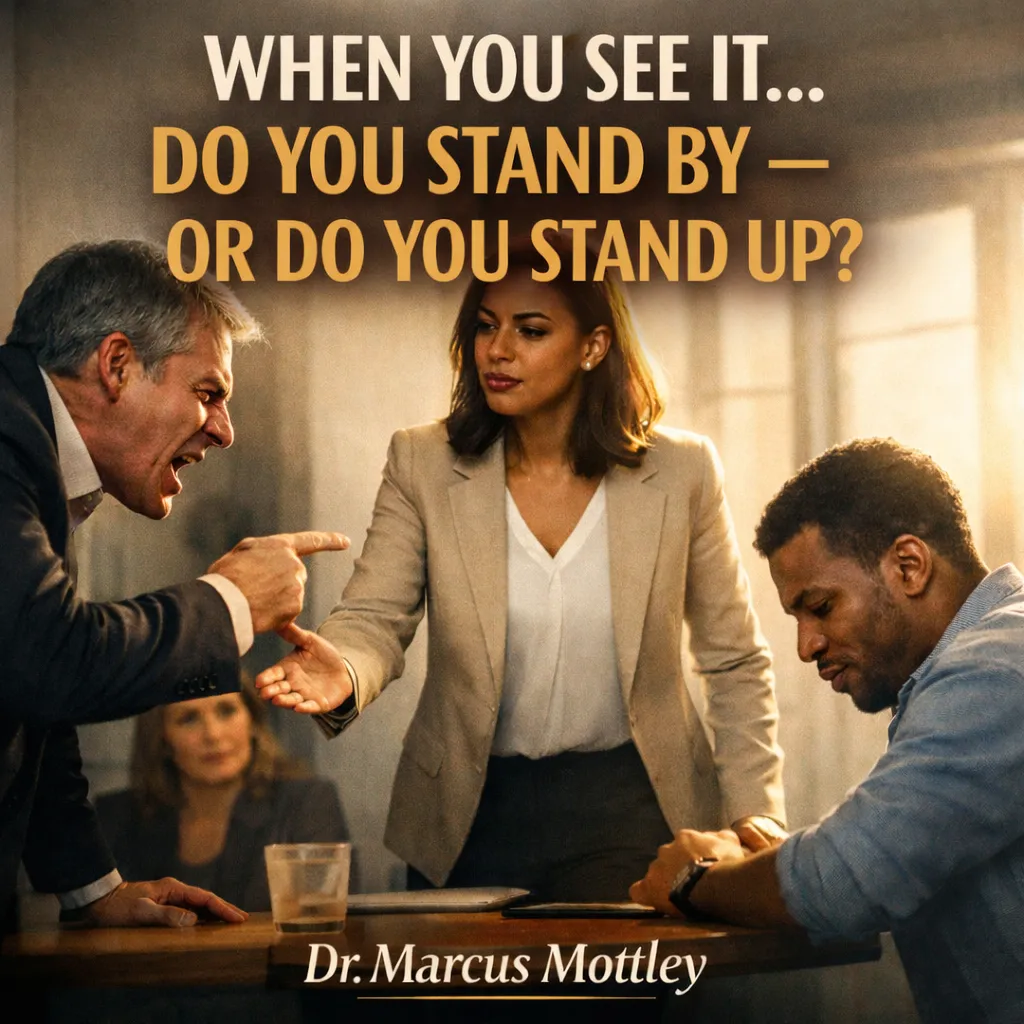
Bystander Intervention At Work: The Shift From Standing By to Standing Up!
There is a moment in the workplace that tests more than your competence. It tests your awareness. It tests your judgment. And ultimately… it tests your courage.
You are in the room. Something happens. You see it clearly. A colleague is interrupted, dismissed, or humiliated. A senior officer raises their voice, crosses a line, and shifts the emotional climate of the space.
And in that moment, you are no longer just an observer.
You are a bystander.
Who Is a Bystander?
A bystander is not a passive individual. A bystander is anyone who witnesses or becomes aware of behavior that warrants comment or action.
This is a critical distinction. Because the moment you become aware, you are no longer neutral.
You are positioned. You can reinforce what is happening… Or you can influence the outcome.
Bystander Intervention, at its core, is the ability to recognize a potentially harmful situation and choose how to respond in a way that positively influences what happens next.
And that word “choose” is where everything begins.
The Hidden Force That Keeps People Silent
If bystander intervention is so important, why don’t more professionals act? The answer lies in a well-documented psychological phenomenon: the bystander effect.
When multiple people are present, individuals are less likely to intervene. Responsibility becomes diffused. Each person assumes someone else will act.
And so… no one does.
In many organizations, harmful behaviors are not sustained because people agree with them.
They are sustained because people hesitate.
The Reality of Workplace Harm
Workplace harm is not always dramatic. It is often subtle, nuanced, and normalized.
It shows up as:
Micro-aggressions
Dismissive comments
Public shaming or humiliation
Exclusion from opportunities
Bullying behaviors
Language that undermines or belittles
These are not isolated incidents. They are patterns. And left unchecked, they can shape the culture of the organization. They can also cause serious emotional harm – also known as Professional Hurt!
Before You Act: The SCOPEs Model
Effective intervention is not impulsive. It is intentional.
Before stepping in, you must quickly assess the situation using a structured lens. This is where the SCOPEs Model becomes essential:
Safety – Are you and others safe?
Control – Can you manage your emotions and words?
Outcome – What is your immediate goal in this moment?
Process – How will you achieve that outcome?
Evaluate – Is the situation changing? Are you still in control?
Support – Do you have support, and are you supporting others?
This model forces you to pause. Not to avoid action… but to ensure that your action is effective, measured, and aligned with your goal.
What Do You Say in the Moment?
One of the biggest barriers professionals face is not knowing what to say. This is where structure becomes power.
The WISH Model provides a clear and controlled way to respond:
When… (name the behavior)
It causes… (state the impact)
So… (make a request)
Here is how… (offer a solution)
For example:
“When you raise your voice and use terms like ‘stupid,’ it creates a hostile environment. So I am asking that we keep the conversation respectful, and here is how you can do that… focus on the issue without labeling the person.”
This approach does not attack the individual. It redirects their behavior.
Taking Action: Use The 5 D’s
Not every situation requires direct confrontation. Effective bystander intervention offers multiple pathways.
The 5 D’s provide flexibility:
Direct – Address the behavior clearly and immediately
Distract – Shift attention to de-escalate the situation
Delegate – Involve someone with authority or influence
Delay – Address the situation after the moment has passed
Document – Record what occurred, if necessary
Each of these strategies allows you to act within your comfort level, authority, and the context of the situation
The key is not how you act.
The key is that you do not remain passive.
A Real Workplace Scenario
Consider this: In a team meeting, a senior officer begins yelling at a junior staff member, slamming the table, and calling them “slow,” “stupid,” and “idiotic.”
The meeting ends. The victim is then given some token support by a senior staffer. And after that… nothing happens. No one speaks up. No follow-up occurs. The perpetrator gets ready to do it again at the next meeting…
This is not just an incident. This is a missed intervention.
The senior staffer acted partially… but not fully. The team witnessed… but did not respond.
And in that silence, a message was sent.
The Shift to Becoming an “Upstander”
At some point in your career, you will face a defining decision. Do you remain a bystander… Or do you become an upstander?
An upstander is not reckless. An upstander is not confrontational for the sake of it. An upstander is intentional, aware, and willing to act in alignment with what is right.
Because here is the truth:
If you do not speak when it matters… You are shaping the culture just as much as the person causing the harm. If you do not stand up… then you are standing by and standing down…
Finally...
Bystander intervention is not about perfection. It is about intervening in incidents that cause professional hurt... It is about participation. It is about moving from hesitation… to intention… to action. Because in the workplace, culture is not defined by policies. It is defined by what people allow… What people interrupt… And what people are willing to stand up for.
So the next time you find yourself in that moment… Do not ask, “Is it my place to intervene?”
Ask instead:
“What is required of me… right now?”
And then… Stand Up!
FAQ
Frequently Asked Questions About Professional Hurt, Emotional Intelligence, and Emotional Resilience.
1. What is Professional Hurt?
Professional Hurt is the emotional, psychological, and often career-related injury that can occur when professionals experience toxic leadership, workplace emotional abuse, chronic invalidation, humiliation, betrayal, intimidation, exclusion, or organizational harm. Unlike ordinary workplace stress, Professional Hurt can continue affecting a person’s confidence, identity, motivation, relationships, and emotional well-being long after the original experience has ended.
2. How is Professional Hurt different from burnout?
Burnout usually comes from chronic stress, overwork, emotional exhaustion, and prolonged demands. Professional Hurt goes deeper. It often involves emotional injury caused by toxic relationships, betrayal, humiliation, bullying, invalidation, or abusive leadership. A burned-out professional may feel depleted. A professionally hurt person may feel wounded, betrayed, diminished, and unsure of themselves.
3. Can toxic leadership cause Professional Hurt?
Yes. Toxic leadership can cause Professional Hurt when leaders use intimidation, public criticism, manipulation, favoritism, emotional invalidation, threats, exclusion, or control tactics instead of emotionally intelligent leadership. Over time, these behaviors can damage trust, confidence, motivation, and psychological safety.
4. Can Professional Hurt affect emotional health?
Yes. Professional Hurt can contribute to anxiety, depression, rumination, sleep problems, emotional exhaustion, loss of confidence, irritability, isolation, and difficulty trusting others. Some professionals continue replaying painful workplace experiences long after they have left the environment because the emotional injury has not yet been fully processed or healed.
5. Why do some professionals suffer in silence?
Many professionals suffer in silence because they fear being judged, labeled as weak, viewed as too sensitive, or punished for speaking up. High-achieving professionals may also minimize their pain because they are used to performing under pressure. Unfortunately, silence often allows the emotional injury to deepen.
6. What role does Emotional Intelligence play in preventing Professional Hurt?
Emotional Intelligence helps leaders recognize the emotional impact of their words, decisions, power, and behavior. Leaders with strong emotional intelligence are more likely to communicate respectfully, manage conflict constructively, repair harm, build trust, and create psychologically safer workplaces. Poor emotional intelligence often increases the risk of emotional damage.
7. How does Emotional Resilience help professionals recover?
Emotional Resilience helps professionals regain stability, perspective, confidence, and emotional strength after difficult workplace experiences. It does not mean pretending the hurt did not happen. It means learning how to process the experience, protect your emotional health, rebuild your sense of self, and move forward without allowing the pain to define your future.
8. How do I know if I have experienced Professional Hurt?
You may have experienced Professional Hurt if a workplace experience continues to affect your confidence, mood, motivation, sleep, relationships, or sense of professional identity. Signs may include replaying painful conversations, dreading work, feeling emotionally unsafe, questioning your competence, feeling betrayed, or struggling to recover from how you were treated.
9. Can leaders repair Professional Hurt after damage has been done?
In some cases, yes. Repair requires honesty, accountability, humility, changed behavior, and emotionally intelligent communication. Leaders must stop minimizing the harm, listen without defensiveness, acknowledge the emotional impact, and create conditions where trust can be rebuilt. However, repair is not possible if harmful behavior continues or accountability is avoided.
10. How can Dr. Marcus Mottley’s work help professionals dealing with Professional Hurt?
Dr. Marcus M. Mottley, brings together clinical psychology, executive coaching, emotional intelligence, leadership development, and resilience training to help professionals understand, assess, and recover from Professional Hurt. His work focuses on helping professionals make sense of workplace emotional injury, rebuild confidence, strengthen resilience, and move forward with greater emotional clarity and professional power.