The Me Mastery Blog
Take Actions That Change Your Life For The Better!
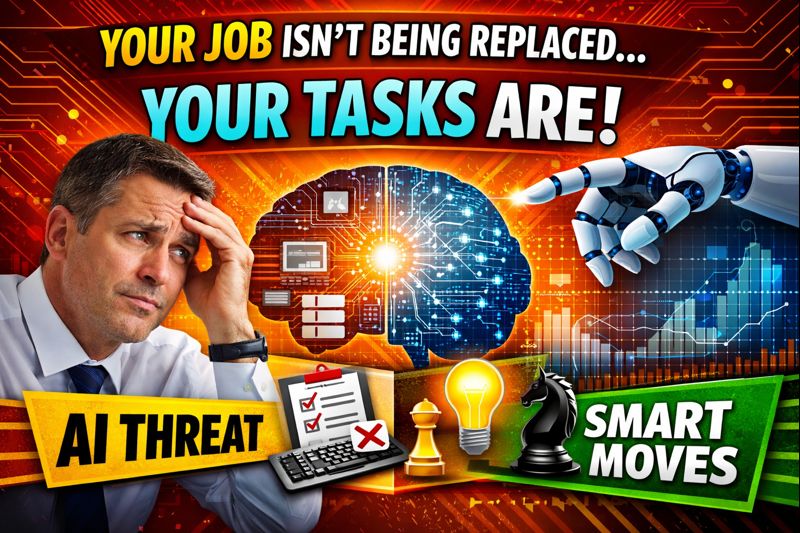
Your Job Isn’t Being Replaced… Your Tasks Are
The 7 Job Tasks AI Is Quietly Erasing, and What Smart Professionals Must Do Next to Stay Relevant
For the past two years, I have been coaching professionals who contacted me because they were anxious, and concerend about the perceived threats to their careers.
They came into coaching sessions asking a familiar question: “Is my job going to be replaced by AI?”
I understand the fear. But I also know, from experience, that this question points them in the wrong direction.
I have worked with mid-career professionals, executives, managers, analysts, clinicians, administrators, and specialists who made a critical mistake early on in their response to the current wave of challenges… particularly from AI. Their mistake is that they focused on their job titles and professional roles, rather than on the specific tasks they performed every day.
Those who stayed stuck on titles panicked, froze, or made poor career moves. Those who learned to analyze their tasks adapted, repositioned, and in many cases quickly accelerated their careers.
AI does not eliminate jobs in one clean sweep. It erodes value by replacing tasks quietly, incrementally, and relentlessly. Once enough core tasks disappear, the job collapses on its own.
Everything that follows in this article is not theoretical. It comes directly from coaching professionals who either learned this lesson the hard way… or used it to future-proof themselves.
Why “Tasks” Matter More Than Job Titles
I have coached two people with the same job title at the same organization and seen dramatically different outcomes.
One lost relevance within 18 months. The other became indispensable.
The difference was not intelligence, education, or work ethic. It was task composition.
When we broke down their week, line by line, it became clear. One person spent most of their time performing tasks that AI could already do. The other spent time interpreting, deciding, influencing, and navigating ambiguity.
This is why I tell professionals bluntly: If you are focused on whether your job will be replaced, you are already late. If you are focused on whether your tasks are replaceable, you still have leverage.
Below are the seven job tasks I consistently see AI replacing first, across industries and professions.
1. Routine Data Entry and Information Processing
I have coached professionals who believed their role was secure because it was “technical” or “specialized,” only to discover that most of their week involved moving data between systems.
AI now ingests, cleans, validates, structures, and stores information faster and more accurately than humans ever could.
Once organizations realize this, they rarely reverse course.
The professionals who survived were the ones who stopped being data handlers and started becoming data interpreters. The rest were quietly phased out or reassigned downward.
2. Standardized Writing and First-Draft Content
I regularly work with professionals whose confidence was shaken when they saw AI produce in seconds what used to take them hours.
Emails. Reports. Summaries. Proposals. Training content. Policy explanations.
AI excels at structured language. It does not get tired or stuck.
The professionals who struggled most were those whose identity was tied to “being the writer.” The ones who thrived learned to shift toward persuasion, framing, narrative, and judgment, skills AI still cannot replicate reliably.
3. Scheduling, Coordination, and Administrative Execution
In executive coaching, I often see talented people trapped in high-effort, low-leverage work.
Meeting coordination. Calendar management. Follow-ups. Deadline tracking.
AI systems now handle these tasks seamlessly.
The professionals who stayed relevant moved upstream. They stopped managing logistics and started expertly engaging their colleagues and customers, managing priorities, making people-based decisions, and engaging in stakeholder dynamics.
4. Rule-Based Decision Making
I have coached professionals in compliance, finance, HR, operations, and healthcare who were shocked to learn how easily their decision frameworks could be automated.
If your decisions follow rules, thresholds, or predefined logic, AI can replicate them consistently and without emotional bias.
The professionals who remained valuable were those who could explain decisions, handle exceptions, challenge assumptions, and demonstrate the application of good judgment even while under the fog of uncertainty.
That distinction matters more than credentials.
5. Basic Customer Support and Predictable Problem Solving
AI is now the first line of customer engagement, support and response in most organizations.
Professionals who relied on scripts and standard responses found themselves replaced quickly. Those who could manage emotional complexity, conflict, and nuance moved into higher-value roles.
In coaching, I often reframe this bluntly: AI handles questions. Humans handle complexities, crises and consequences.
6. Simple Analysis and Reporting
Many professionals still believe that generating reports is valuable work.
It is not. At least, not any longer.
AI can produce dashboards, summaries, comparisons, and trend analyses instantly.
What organizations now need are professionals who can answer: What does this mean? Why does it matter? What should we do next?
I have seen careers stall simply because people stayed in analysis rather than moving into insight.
7. Process Execution Without Judgment
If your work follows a clear sequence with limited discretion, it is highly vulnerable. Why? Because AI thrives on clarity and repetition.
Professionals who stayed safe were those who redesigned their role to include decision-making, adaptation, and leadership, not just execution. And if they could not redefine their roles, they repeatedly demonstrated, in meetings and conversations, that they had the ability to adapt while correctly forecasting, predicting and reading the data in nuanced ways that AI could not.
What I Advise Professionals to Do Instead
Every successful client I have worked with eventually made the same strategic shifts.
Here are the five moves that consistently protected and advanced their careers.
1. Perform a Ruthless Task Audit
We list every recurring task in their week and ask one question: Could AI do this faster, cheaper, or at scale?
This exercise is uncomfortable. It is also transformative.
2. Move From Output to Judgment
AI produces outputs. Humans must own judgment. Clients who thrived became known for their ability to interpret, prioritize, contextualize, and decide under pressure.
3. Strengthen Emotional Intelligence Deliberately
This is where many professionals underestimate the future.
Influence, self-regulation, empathy, conflict navigation, ethical reasoning, and leadership presence are not optional. They are career insulation.
This is why EQ development is not separate from AI strategy. It is foundational to it.
4. Use AI as a Force Multiplier
The most successful professionals I coach do not compete with AI. They command it. They use AI to draft, analyze, plan, and simulate scenarios so they can focus on higher-level thinking and human engagement.
AI becomes leverage, not threat.
5. Reposition Before You Are Forced To
The professionals who waited for organizations to redefine their role were usually disappointed.
The ones who proactively reshaped their contribution became indispensable.
The Truth Most Professionals Learn Too Late
Your job title may survive the AI era. But, your task list may not. And you probably will follow your task out of the door.
You’ve probably heard me say this before. The professionals who succeed are not the most technical or the hardest working. They are the most strategic about where value is moving and how humans remain essential within it.
I have seen this pattern repeatedly across industries, roles, and career stages. AI does not end careers overnight.
It dismantles them quietly… one task at a time.
And the professionals who understand that distinction early on are the ones who stay standing.

© 2025 All Rights Reserved - Dr. Marcus Mottley