The Me Mastery Blog
Take Actions That Change Your Life For The Better!
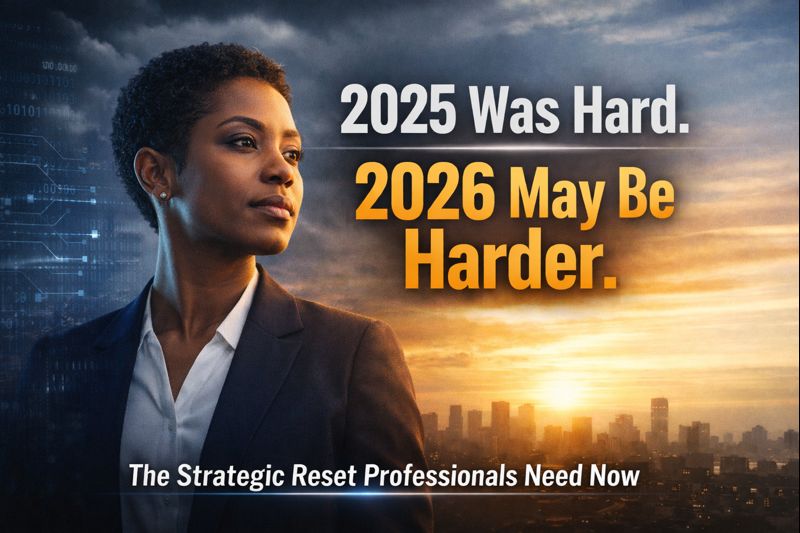
2025 Was Hard. 2026 Will Be Harder…
Let’s be honest. For many professionals, 2025 felt like a year of quiet grief. No… Not the dramatic kind… but the slow erosion of certainty and self-confidence.
Roles were redefined. Tasks were automated. Jobs were decimated. Budgets tightened. Political decisions reshaped industries and economies overnight. And AI stopped being “interesting” and started being threatening.
But here is the reframing that matters most right now: 2025 is not a year to mourn. It is a year to mine and examine. Because if 2026 turns out to be more volatile than 2025, and all signs suggest it may be, then reflection without strategy becomes regret. You are not to blame for what happened in 2025. You are not even to blame for your response to what happened in 2025. But… if you don’t respond differently now… then in 2026… you will be responsible for what happens to you…
This article is not about optimism. It is about preparedness.
So… hare are seven strategic moves professionals must consider now, not in panic, but with clarity, intention, and resolve.
1. Reframe 2025 as Data, Not Damage
Here is the first uncomfortable truth: Your emotional reaction to 2025 may be understandable… but it is not useful.
Instead of asking, “Why did this happen to me?” Ask instead, “What did 2025 reveal about where I am vulnerable?”
Where did AI encroach first? Which tasks lost value? Where did decisions outside your control expose fragility?
2025 was a stress test. Treat it like one.
Professionals who win in 2026 will not be the most talented… they will be the most diagnostic.
If you think in shallow terms, then you will see the past only as history. However, the past few years should also show you a pattern. In other words… think of the word ‘trend’. First there was the recent global Pandemic. While that was ending, AI emerged and has quickly become the global ‘workdemic’. And then, the guy with the yellow hair emerged and singlehandedly created worldwide havoc economically and otherwise.
So… with these recent trends, we all need to behave differently... no matter how we think or feel.
2. Stop Thinking in Jobs. Start Thinking in Tasks
If you are still asking, “Will my job exist in 2026?” you are asking the wrong question.
The better question is: “Which parts of what I do are already being replaced, accelerated, or devalued?”
Jobs are bundles of tasks. AI does not replace jobs, it dismantles task clusters.
Your survival strategy is simple, but not easy:
·Identify which tasks AI can now do faster or cheaper
·Reduce your identity attachment to those tasks
·Reallocate your human energy to judgment, decision-making, influence, and relationship-based value
This is not theoretical. It should not be emotional. It is operational.
3. Build Psychological Resilience Before Technical Skill
Most professionals panic because they confuse fear with urgency. Fear narrows thinking. Urgency sharpens it.
Before learning another tool, platform, or system, you must stabilize your internal operating system.
Ask yourself: How do I respond under uncertainty? Do I freeze, avoid, overwork, or numb out? What happens to my confidence when external validation disappears?
In 2026, emotional regulation will be a competitive advantage.
Those who manage anxiety think strategically. Those who don’t… react tactically. If you are wringing your hands and asking yourself “What am I going to do tomorrow?”, then you are reacting tactically.
You should, instead, be asking yourself: “What do I want the next year to be like?”, “How am I going to get there?” and, “What is my top goal?”… and then, “What are my first steps to begin to achieve that goal...?
4. Use AI as a Force Multiplier, Not a Competitor
Here is the paradox most professionals miss: AI is not replacing strategic professionals. It is replacing unsupported professionals.
The winning posture is collaboration, not resistance.
Use AI to:
·Draft before you refine
·Analyze before you decide
·Outline before you execute
·Reduce friction before you expend willpower
AI should free you to think, not tempt you to disappear.
If AI is doing more of your work, your responsibility is to do higher-level work, not less work.
5. Increase Your Strategic Visibility
In unstable environments, invisibility is dangerous.
You do not need to be loud. You need to be legible.
Ask yourself:
·Do decision-makers understand how I create value?
·Can they explain my contribution clearly to others?
·Am I known for outcomes… or activity?
2026 will reward professionals who are easy to advocate for. Clarity in your value to the organization begins to create protection. It’s not the only thing… but it’s the top thing.
6. Diversify Your Career Risk
The old model was linear. One role. One employer. One income stream.
That model is now fragile. This does not mean quitting your job. It means reducing single-point failure.
Consider the importance of the following:
·Adjacent skills that travel across industries
·Thought leadership, teaching, mentoring, or advising
·Portable expertise that is not tied to one organization’s budget
Optionality is not disloyalty to the organization. It is risk management for you the professional.
7. Commit to Fewer, Deeper Moves
The final trap professionals fall into is overreaction.
Too many goals. Too many tools. Too many half-starts. To many ‘starting over’ efforts. Too much second guessing of your professional value and contribution. Too much focus on all of the new shiny tech and AI toys and tools.
2026 will punish scattered energy. Choose fewer moves… but execute them deeply.
One skill upgrade that compounds. One visibility strategy that clarifies value. One resilience practice that stabilizes your thinking.
Commitment beats intensity.
Finally, reflect on this:
2025 tested your assumptions.
2026 will test your decisions and your plans… and then your actions to achieve them.
This is not about predicting the future. It is about preparing for volatility without losing yourself.
The professionals who thrive next year will not be the most confident. They will be the most intentional.
If this reflection helped you slow down, think clearer, and feel more grounded… then it has already done its job.
Now the question is simple:
What will you do differently, starting now, so that 2026 does not repeat 2025?